

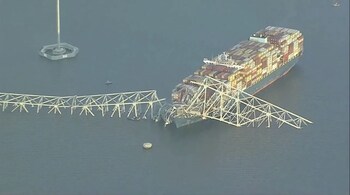
US officials have expressed concern about the implications rippling beyond the immediate region after a key bridge harbouring America's largest vehicle handling port collapsed in Baltimore when a cargo ship crashed into it, even as experts predicted repercussions to be "modest and mainly localised".
The 2.6km-long, four-lane Francis Scott Key Bridge over the Patapsco River in Baltimore was destroyed after Dali, a 984-foot cargo ship bound for Sri Lanka, collided against a bridge column in the early hours of Tuesday. The collapse of the bridge has indefinitely halted the flow of ships in and out of Baltimore Port.
We are concerned about the local economic impact, with some 8,000 jobs directly associated with port activities," US Transportation Secretary Pete Buttigieg told reporters in the White House on Wednesday. "We're concerned about implications that will ripple out beyond the immediate region because of the port's role in our supply chains, he said, describing the Baltimore port as important for imports and exports given that it is America's largest vehicle handling port.
No matter how quickly the channels can be reopened, we know that it can't happen overnight. And so, we're going to have to manage the impacts in the meantime, he said. The Congressional Research Service (CRS) said that the Baltimore port was the 17th busiest by total tonnage in the United States in 2021. It was the 10th busiest by dry bulk tonnage and the 15th busiest container port in TEUs (Twenty-foot equivalent unit).
Joseph Schofer, Professor Emeritus of Civil and Environmental Engineering at the Robert R. McCormick School of Engineering and Applied Science at Northwestern University, underlined that some cost increases can be expected. Arguably, the Baltimore route was selected in the past because it was preferred for cost or efficiency reasons. Now, shipments move to the second-best routes until the port is reopened, Schofer told PTI.
Schofer said there will also be delays as these other ports will take more time, although that may also adjust as shippers optimise their on-the-ground paths or modes. So, expect things to get worse quickly and better slowly, he said.
He, however, predicted the economic repercussions of bridge collapse to be modest and localised. I think the economic repercussions will be modest and mainly localised," he said.
"Baltimore has always been a significant port, but lately, its specialities have been coal exports and automobile imports – some machinery exports. Of course, many other commodities flow through the port of Baltimore, but in lesser quantities, Schofer said. "I do not see impacts around the globe being very great. This more a local matter, he said, adding that there are alternative paths in and out.
He pointed out that the Interstate-695 route/Key Bridge path carried trucks in and out of distribution centres in the inner harbour area, especially on the east side. Those trucks will now have to follow longer and more time-consuming paths.
Shippers, including online retailers like Amazon, may temporarily shift to warehouses in different locations to avoid the congestion of central Baltimore. These are likely to be swift and relatively low-impact adjustments, he said. The CRS has said that containers at Baltimore port awaiting export could be moved to other ports by truck or rail.
However, dry bulk-such as coal, the largest commodity by volume handled by the port- and farm and construction machinery may be more difficult to move through other ports, as specialised facilities are needed for loading and unloading. The closest large ports to Baltimore are Wilmington in Delaware, Philadelphia in Pennsylvania and Camden in New Jersey.
According to the Maryland Port Administration, the port is responsible for nearly USD 3.3 billion in personal wages and salaries, USD 2.6 billion in business revenue, and nearly USD 400 million in state and local tax revenue annually. Industry body Alliance for Automotive Innovation CEO John Bozzella said in a statement that while it is too early to tell what impact the incident will have on the auto business, there will certainly be a disruption.
The Alliance said the port's vehicle terminals moved more than 750,000 vehicles in 2022, including 573,831 imports and 176,332 exports. In 2023, motor vehicles and parts accounted for 42 per cent of all port imports (about USD 25 billion) and 27 per cent of all port exports (about USD 6 billion), with motor vehicles and parts accounting for 38 per cent of total port trade of about USD 30.6 billion.
Meanwhile, Schofer outlined a two-phase recovery process, including harbour clearance, which will immediately reopen the port. Marine operations will return to some version of normal. That can happen quickly – three to six months, he said, adding that this won't start until victim recovery is completed and the National Transportation Safety Board releases the site when its on-scene investigation ends — a process that could take weeks.
The second phase of recovery would entail reconstruction of the bridge, which he said could take 18 months to three years, maybe more if priorities change. He noted that the bridge requires a total rebuild, which is a long-term and expensive project.
JPMorgan economists Michael Feroli and Daniel Silver said in a note, cited by Investopedia.com, that their initial assessment is that the bridge collapse will likely only have minimal implications for vehicle inflation. While Baltimore is the most important port for vehicle imports, many more are imported overland from Canada and Mexico.
Moreover, within less than 24 hours of the disaster, vessels were already diverted to other East Coast ports, and according to the Port of Virginia, those ports will have sufficient capacity to handle all the diverted cargo, they said. They noted that the larger impact will likely be on everyday commuter traffic in Baltimore and the eastern corridor.
The bridge had an annual average daily traffic of 33,195 vehicles in 2022 and an annual average weekday traffic of 38,014 vehicles. According to the CRS, highway traffic could be rerouted through the Baltimore Harbor or other routes. Credit rating agency Morningstar DBRS noted that in 2023, the Port of Baltimore handled over USD 80 billion in cargo, and more than 140,000 jobs depend on this natural harbour.
The bridge collapse and the port's subsequent blockage will trigger a large number of insurance policies, including marine liability and hull, property, cargo, and business interruption, it said. Depending on the length of the blockage and the nature of the business interruption coverage for the Port of Baltimore, insured losses could total between USD 2 billion and USD 4 billion, it said.
Discover the latest Business News, Sensex, and Nifty updates. Obtain Personal Finance insights, tax queries, and expert opinions on Moneycontrol or download the Moneycontrol App to stay updated!





