

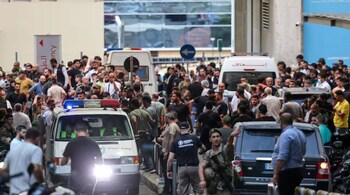
In a devastating turn of events, Lebanon was rocked by a series of deadly explosions over two days, leaving a trail of destruction and heartache. The attacks, believed to be orchestrated by Israel, targeted Hezbollah, the Iran-backed militant group that has been responsible for rocket attacks on northern Israel.
The explosions, which occurred in homes, offices, and even during funerals, were triggered by pagers and two-way radios used by Hezbollah militants. The scale of the devastation, coupled with the precision of the attacks, pointed to a meticulously planned operation by Israeli intelligence. At least 30 people were killed, and thousands were injured in these explosions. The attacks have left Hezbollah reeling, stunned by the devastating blow dealt by Israel's intelligence agency, Mossad.
According to a New York Times report, an operation targeting Hezbollah involved pagers, once seen as secure, being turned into weapons. The chaos began at 3:25pm on Tuesday when two Hezbollah members' pagers exploded at a mall, followed by another blast at a Hezbollah office. Within minutes, hundreds of pagers across Lebanon and Syria detonated nearly simultaneously. Eyewitnesses described scenes of utter chaos: “men flying off motorcycles, shoppers collapsing in agony, smoke snaking from pockets.” The report quoted Mohammed Awada, 52, “My son went crazy and started to scream when he saw the man's hand flying away from him.” The attacks disrupted public spaces and penetrated Hezbollah’s infrastructure, including explosions at a funeral for earlier victims.
Sophisticated Israeli Operation
According to the New York Times, Israel executed a sophisticated operation using a front company, BAC Consulting, purportedly a Hungary-based firm contracted by Taiwan’s Gold Apollo to produce pagers. In reality, it was an Israeli intelligence ploy. The pagers, which Hezbollah thought would protect them from surveillance, contained batteries laced with the explosive PETN. The deception was so meticulous that even the company’s website and LinkedIn profiles were convincingly crafted. The operation didn't stop there. The next day, walkie-talkies and other electronic devices used by Hezbollah exploded, showing a multi-layered strategy. Though Israeli officials have not confirmed their involvement, it's widely believed that Mossad orchestrated the attacks. Israeli Defense Minister Yoav Gallant announced a “new phase” in the conflict, stating, “The center of gravity is shifting to the north by diverting resources and forces.” An Israeli general added, “We have many capabilities that we haven’t yet activated,” signalling a stern warning to Hezbollah.
Some Operations conducted by Mossad
Operation Wrath of God (1972-1979): Israel targeted individuals responsible for Munich Olympics attack
Capture of Adolf Eichmann (1960): Nazi war criminal abducted from Argentina
Operation Entebbe (1976): Hostage rescue operation in Uganda
Stuxnet Cyber Attack (2008): Iran's nuclear programme disrupted
Theft of Iran's nuclear Secrets (2018): Mossad stole documents from Tehran
Assassination of Imad Mugniyeh (2008): Killed Hezbollah commander Mossad’s Precision and Strategic Intent
The recent attacks on Hezbollah are not an isolated incident. Mossad, Israel's intelligence agency, has a long history of conducting covert operations, including assassinations and sabotage missions. The agency has gained a reputation for its surgical precision in targeting high-profile individuals, such as Iranian nuclear scientists and Hezbollah leaders. According to a Foreign Policy report, Mossad’s pager attack on Hezbollah was driven by the need to restore its “omnipotent and omnipresent” image, especially after the assassination of Hamas leader Ismail Haniyeh in Tehran in July. The attack signals that Israel might be preparing for war with Hezbollah. Since October 7th, 2023, Hezbollah's rocket fire into Israel has intensified, escalating tensions at the northern border.
According to the report, the pager explosions were likely meant to disrupt Hezbollah’s infrastructure and send a message that Israel could strike at any time. A retired Israeli military official remarked, “Why didn’t we do it for 11 months? Because we were not willing to go to war yet. What’s happening now? Israel is ready for war.” The attack has delayed Hezbollah’s operations, forcing the group to repair its communication network and investigate potential infiltrators. Despite this tactical victory, Israel still faces the challenge of containing threats from Hezbollah, Hamas, and Iran without triggering a wider regional conflict. For Hezbollah, the incident highlights its vulnerability to Israeli intelligence.
Regional Tensions
The aftermath of the pager attacks has left Hezbollah in a state of paranoia, as thousands of its operatives’ secret affiliations were exposed to family and neighbours, eroding trust within the group and its civilian base. This incident could heighten tensions in Lebanon, raising concerns about the vulnerability of imported electronics. Iranian-aligned militias are now worried that more devices—phones, tablets, radios—could be similarly compromised. As Lebanon deals with this tragedy, the region risks a broader conflict. The attacks might signal a larger campaign against Hezbollah or be a strategic move in the ongoing geopolitical struggle.
Israeli Prime Minister Benjamin Netanyahu's remark about returning northern residents safely hints at potential further action. The line between peacetime and war, and between civilian technology and weapons, is increasingly blurred. As one Lebanese woman warned, “Turn off your phones now!”—highlighting the new reality where even everyday devices can become instruments of war.
(Inputs from agencies)
Discover the latest Business News, Sensex, and Nifty updates. Obtain Personal Finance insights, tax queries, and expert opinions on Moneycontrol or download the Moneycontrol App to stay updated!





