

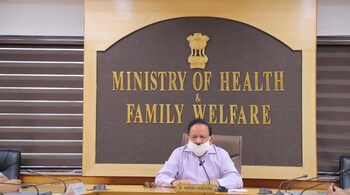
Union Health Minister Dr. Harsh Vardhan has reiterated that there is no community transmission of the novel coronavirus in India, in the current situation.
Speaking to CNN-News18, Harsh Vardhan said that there is no permanent definition of the term ‘community transmission’. “There was some localised transmission in places like Dharavi (in Mumbai), but it was effectively contained,” he said.
He asserted that all mathematical predictions by experts on number of COVID-19 cases and mortality rate in India had been proven wrong.
The union health minister also said that the notice by the Indian Council of Medical Research (ICMR), pushing for fast tracking of a COVID-19 vaccine candidate was “misinterpreted”.
“We are following all standards for the creation of a vaccine. We do not want to give any timeline. Our scientists are on the job. It will be great if we can get the vaccine in the next few months,” he added.
Seeking to end the controversy over a possible hurried attempt at developing an indigenous vaccine against the novel coronavirus, the ICMR, on July 5, had said it has not set an August 15 deadline for the drug.
The medical authority had said its aim was to complete the vaccine’s clinical trials as soon as possible, similar to candidates in other countries.
Follow our LIVE blog for the latest updates of the novel coronavirus pandemic
Asked if India had relaxed the nationwide lockdown measures early, the health minister said: “We did not open to soon. States going for a lockdown is a localised modification of rules. It is alright for them to locally do it for containing the virus.”
On reports of black marketing of remdesivir, the antiviral drug for the treatment of severely ill COVID-19 patients, Vardhan said, “We have taken action against the black marketers. We are taking measures to ensure that this does not happen. We are monitoring this situation. We have told agencies to make data of the medicine available on their websites”. He added that arrests had been made in such cases.
Total confirmed cases of novel coronavirus infections in India stands at 8.7 lakh. While 5.5 lakh patients have recovered so far, 23,174 have died.
Click here for Moneycontrol’s full coverage of the novel coronavirus pandemic
Discover the latest Business News, Sensex, and Nifty updates. Obtain Personal Finance insights, tax queries, and expert opinions on Moneycontrol or download the Moneycontrol App to stay updated!





