

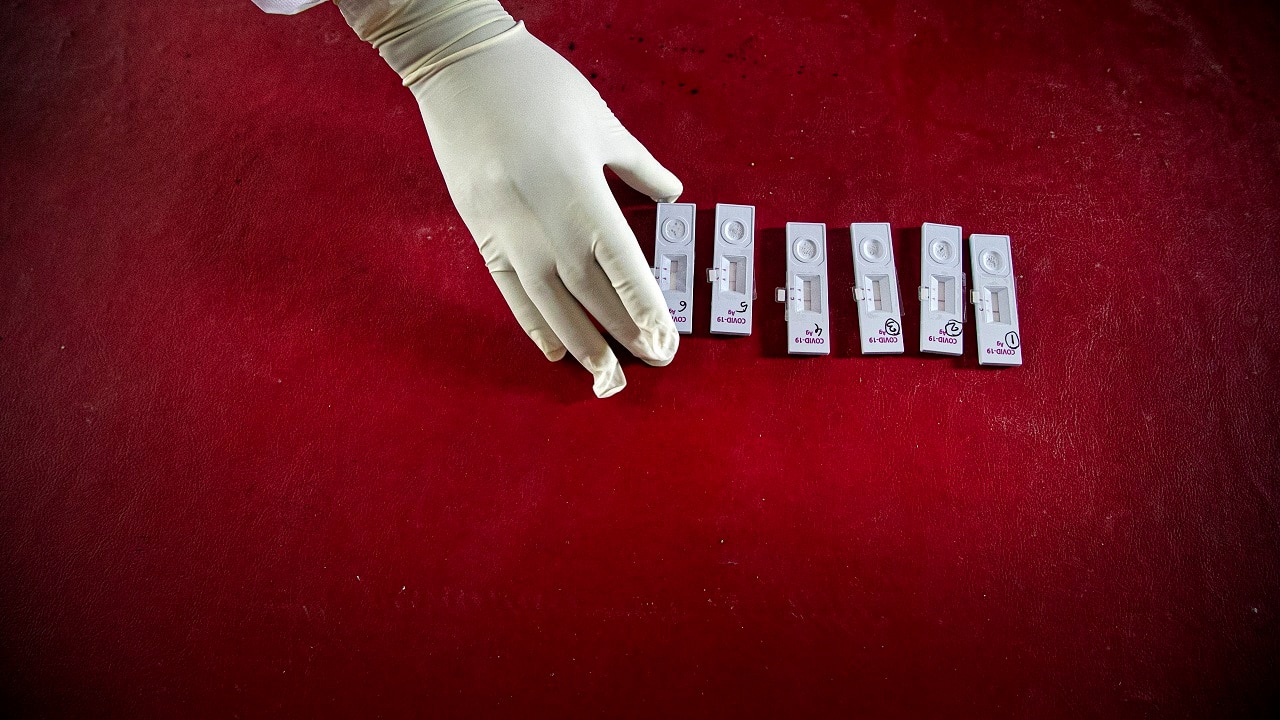
Over the past few weeks, a Harvard scientist has made headlines for a bold idea to curb the spread of the coronavirus: rolling out so-called antigen tests, a decades-old underdog in testing technology, to tens of millions of Americans for near-daily, at-home use.
These tests aren’t very good at picking up low-level infections. But they are cheap, convenient and fast, returning results in minutes. Real-time information, argued Dr. Michael Mina, would be a lot better than the long delays clogging the testing pipeline.
The fast-and-frequent approach to testing has captured the attention of scientists and journalists around the world, as well as top officials at the Department of Health and Human Services.
Deployed often enough and widely enough, speedy tests could “really squash the virus,” Mina said. “I think it’s crazy not to get behind this.”
But more than a dozen experts said that near-ubiquitous antigen testing, while intriguing in theory, might not fly in practice — and is unlikely to be a pandemic panacea. In addition to posing herculean logistical hurdles, they said, the plan hinges on broad buy-in and compliance from a country full of people who have grown increasingly disillusioned with testing for the virus. And that is assuming that rapid tests can achieve their intended purpose at all.
“We are open to thinking outside the box and coming up with new ways to handle this pandemic,” said Esther Babady, director of the clinical microbiology service at Memorial Sloan Kettering Cancer Center in New York.
But antigen tests that could work at home have yet to enter the market, she said. And no one has yet done a rigorous study to show that fast-and-frequent trumps sensitive-but-slow in the real world, she said.
“The data for that is what’s missing,” she said.
Although fast-and-frequent testing could work, what’s been put forth so far about the approach has been “largely aspirational, and we need to check it against reality,” said Dr. Alexander McAdam, director of the infectious diseases diagnostic laboratory at Boston Children’s Hospital, who recently co-authored an article on pandemic testing strategies in the Journal of Clinical Microbiology.
Most of the coronavirus tests run so far rely on a laboratory technique called PCR, long considered the gold standard of infectious disease diagnostics because it can pick up even very small amounts of genetic material from germs like the coronavirus.
But sputtering supply chains have compromised efforts to collect, ship and process samples for PCR, driving delays in turnaround times. The longer the wait, the less useful the result. PCR also isn’t cheap or user-friendly, making it an unlikely candidate for widespread home use.
The at-home arena is where antigen tests could shine, Mina said. At their simplest, they might function much like a pregnancy test, analyzing bodily fluid and spitting out a result within a few minutes, no health workers or fancy machines necessary.
As Mina sees it, these tests could be crafted from materials as cheap as cardboard and be shipped like rations to communities around the country. They would act as bouncers at the entrances to schools or workplaces, and allow Americans to check themselves at home for the coronavirus several times a week, perhaps even daily.
But achieving that reality would require an antigen test that is not yet approved for widespread use, and the infrastructure to manufacture it en masse. Only four antigen tests so far have received emergency approval from the Food and Drug Administration and are intended to be used by health care workers on people who recently showed symptoms. All of them also rely on swabs to collect test samples, and three require somewhat bulky and expensive machines to read out results.
“We just don’t have tests ready to occupy this space right now,” McAdam said.
Several companies have other rapid tests in development. But there is no guarantee that newcomers will meet FDA standards. And the past few months have clearly demonstrated that no test is impervious to shortages.
“There’s no reason to believe that the supply chain issues we’ve encountered with all other coronavirus testing will not still be an issue here, too,” said April Abbott, microbiology director at Deaconess Health System in Indiana. “We can’t build new product lines overnight.”
Experts also noted that antigen tests aren’t great at sussing out small amounts of the coronavirus, which means they are far more likely to miss a case that a technique like PCR would catch. Some antigen tests catch only half the infections they look for. And while some new products perform better in the lab, advertised accuracy rates will almost certainly drop when used at home, said Linoj Samuel, a medical microbiologist at Henry Ford Health System in Michigan.
(Some have argued that PCR may actually be too sensitive in some settings, picking up on scraps of innocuous coronavirus genetic material in patients who are no longer sick; antigen testing could circumvent this.)
Mina argues that dips in quality could be overcome with quantity: Near-daily tests would be able to identify infections on the cusp faster than the backlogged PCR pipeline could, helping people self-isolate in the nick of time. From a public health perspective, what matters most is finding people at the peak of infection — something that even antigen tests should be able to do with high levels of accuracy, he said.
But researchers don’t yet know how much virus someone has to have in their body to be contagious — the amount almost certainly varies from person to person. And there will inevitably be exceptions to the “more virus, more transmission” trend.
“We just don’t have any proof that a negative test result means you’re not infectious,” said Susan Butler-Wu, a clinical microbiologist at the University of Southern California’s Keck School of Medicine.
Some antigen tests miss up to 18% of cases shown by PCR to involve high levels of the coronavirus.
The opposite issue, false positives, are rarer with antigen tests, but they do happen. In July, dozens of positive antigen tests that had officials in Manchester, Vermont, bracing for an outbreak turned out to be errors. And in August, Gov. Mike DeWine of Ohio tested positive for the coronavirus by an antigen test, only to test negative thrice in a row by PCR.
In regions where the virus has infected only a few people, the number of false positives could end up dwarfing the number of true positives.
McAdam said that widely deploying a test with imperfect specificity to a region where the virus is scarce “is a bad idea, and I’ll die on that hill.”
High rates of inaccurate results, coupled with continued confusion about the deluge of new coronaviruses tests, could fuel public skepticism of science at a particularly precarious time, said Amanda Harrington, director of the clinical microbiology laboratory at Loyola University Medical Center in Illinois.
In the past six months alone, coronavirus tests have been alternately billed as game-changers and national embarrassments, seeding a sense of perpetual whiplash among testing experts.
“My own family is telling me they’re not sure what to believe,” Harrington said. “You’re eroding confidence to the point where people don’t trust it.”
And a nation of people wary of tests will probably be less likely to take them regularly, even if they are available at home.
Uma Karmarkar, a human behavior expert at the University of California, San Diego, said it is possible that compliance would be low for the fast-and-frequent approach. She pointed to the example of daily medications, like birth control pills, as well as spotty use of masks.
“Even when there’s a vested interest, there’s slippage,” she said.
With near-daily testing, even cheap products could add up to big bills, further disincentivizing use. (Mina said the federal government should foot the bill to avoid that issue.)
A subset of people might still adopt the fast-and-frequent approach with enthusiasm, Karmarkar said. But that could be a skewed sector of the population, such as those who are already more inclined to trust the medical system, and could exacerbate the pandemic’s health inequities.
Until more data is gathered to support the fast-and-frequent approach, Samuel proposed a tentative middle ground. Schools, universities and workplaces may be good candidates for regular antigen testing, for example, whereas hospitals and other medical care settings would still prioritize PCR.
“The whole idea is to use the right test for the right patient at the right time,” Babady said.
Mina agreed, noting that PCR remains crucial for diagnosing sick patients — a situation that calls for the most sensitive test, so the right treatments can be administered.
Still, he remains optimistic that the fast-and-frequent strategy could make a major dent in the nation’s coronavirus catastrophe. That should be incentive enough, he said.
“I truly believe people will want to use these tests,” he said.
c.2020 The New York Times Company
Discover the latest Business News, Sensex, and Nifty updates. Obtain Personal Finance insights, tax queries, and expert opinions on Moneycontrol or download the Moneycontrol App to stay updated!





