

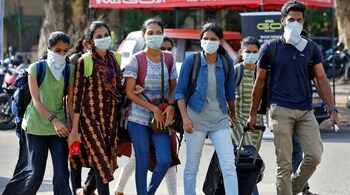
Amid the second COVID-19 wave, feared to be triggered by the more contagious coronavirus variants, experts are suggesting the use of 'double masks' to minimise the chances of infection.
For double masking, a surgical mask should be a worn with a cloth mask over it, explained All India Institute of Medical Sciences (AIIMS) Director Dr Randeep Guleria.
Ideally, one should wear the N-95 masks as they have a filtration capacity of 90 percent, the AIIMS chief said. But since the N-95 masks may not be easily available, the next best option is double masking - with an inner layer of 3-ply surgical mask and a cloth mask over it, Dr Guleria was reported as saying by News 18.
Also read: Heartbreaking photos emerge from hospitals as COVID-19 2nd wave hits India hard
Recent studies conducted by the United States Centre for Disease Control and Prevention (CDC) - the country's top public health agency - found that double masking could minimise the risk of virus exposure by up to 95.9 percent.
The CDC study found that unknotted surgical mask alone blocked cough particles by 56.1 percent, and cloth mask alone by 51.4 percent.
A combination of both - a knotted surgical mask and a cloth mask over it - blocked cough particles by up to 85.4 percent.
When the source (person infected with COVID-19) and receiver were both fitted with double masks, the cumulative exposure of the receiver was reduced by 95.9 percent, the study claimed.
The CDC, however, stressed that wearing masks in the appropriate manner is essential to minimise the exposure to the virus. "In lab test with dummies, exposure to potentially infectious aerosols decreased by about 95 percent when they both wore tightly fitted masks," the health agency claimed.
Dr Guleria also reiterated the point, stating that the "most important thing is to wear the mask properly".
"You need to ensure, the air comes through the filtering mechanism of the mask otherwise you will get infected. Taking a deep breath and seeing the mask getting sucked in can tell you whether you’re wearing it properly or not," he said.
Discover the latest Business News, Sensex, and Nifty updates. Obtain Personal Finance insights, tax queries, and expert opinions on Moneycontrol or download the Moneycontrol App to stay updated!





