

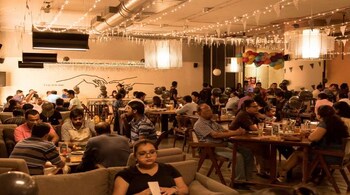
If you thought that the restaurant industry has been hit hard by the global pandemic, here is far more troubling news: bars are having it tougher.
Restaurants can mitigate losses with home deliveries, curated experiences, online master classes and bakeries. There is also the possibility to open up with social distancing norms. But how do you open up a space that is made for people jostling, packed like Mumbai’s pre-COVID day’s peak-hour rush in a local train compartment? Unless you are referring to a fancy bar in an equally fancier hotel, even the most upmarket bars do not allow for social distancing.
Globally, there are instances of how bars were forced to shut down within days of opening up and are being viewed as crucibles for infection spread. A July 3, 2020 report of trade association Hospitality (UKH), which tracks bars and restaurants in London, states, “No hotel buffets, no cutlery laid out on tables, and no drinks at the bar!”
It goes on to mention: Customers will be “discouraged” from returning empty glasses. Restrictions on people staying at the bar once they’ve ordered their drinks have been proposed, along with socially distanced queues to order drinks, with tape on the floor showing an appropriate distance to stand.
A ‘bar café’, anyone?
Indian bars and pubs are intently watching the action as it unfolds in London, New York and other cool cities across the world, which has begun to open up at a furious pace, to pick up some lessons in what an after-COVID world holds for them.
A few crucial facts: There are approximately 30,000 F&B outlets across India, as per the National Restaurant Association of India (NRAI) data, many of them MSMEs or standalone outlets with the low-cash flow. It is estimated that this segment may contract by 30 percent because of the COVID impact. The industry employs 7.2 million people and expects more than a third to lose their jobs for lack of any institutional support.
As Zorawar Kalra, Founder and Managing Director, Massive Restaurants, which owns quite a few bars across cities such as Mumbai and Delhi, says, “Bars and microbreweries rely on liquor for sales and most diners go there to have drinks, rather than eat the food. India hasn’t allowed restaurants to serve liquor as yet, so bars haven’t been able to figure a way ahead. They are losing revenue and are facing an existential crisis.”
The microbreweries, particularly, seem to be inextricably in trouble; they have been battered at two fronts. Vipul Hirani, co-founder, Crafters Taphouse points to a crucial fact: Breweries that have their taprooms have not seen any revenue for the last four months and are unlikely to resume operations soon. Breweries that just distribute their beer to restaurants have not been paid by customers since January, as they usually offer a 45-day credit period. “With several restaurants shutting rapidly, it is highly likely that we will have to write off those payments.”
The situation is complicated by the limited options for home delivery. “There are no confirmed laws that allow bars to provide cocktail deliveries or experiences at home,” says Akriti Agarwal, CEO, Thirsty Beers and Thirsty City127. There never was any need for it; going to a bar was an experience that involved the ambiance, the sound, the noise, the music, as much as the drinks.
In their small ways, bars are attempting to find a few sources of income. Unlike in the US or UK, where cocktails-on-the-go, sold by some of their best bars, have kept their businesses going during lockdowns, delivery of alcohol isn’t allowed in India. “All the bars can do is sell mixers without alcohol. These are pre-made cocktail mixes that are sent to people’s houses, where they can add them to their alcohol based on a confirmed recipe,” reveals Kalra.
The survival plan
For the situation to even begin to make sense, consumer sentiment needs to change. At Kalra’s bars, some fundamental changes are being put together at the ground level. But the biggest transformation is being brought to pass by the use of technology. YOUnion uses special robots to serve drinks. It is an idea that the West in perfecting (the job losses are evident, but for the moment, safety is paramount to keep businesses afloat). This, besides ensuring distance between tables and staff kitted out in PPE that the authorities mandate.
So many bars are selling cocktail mixers. The Maharashtra government has tried to work around the pain points of microbreweries by approving the sale of growlers (a glass, ceramic, stainless steel, but increasingly plastic, bottle). “The sale of beer in the form of growlers will not just help microbreweries but also restaurants, as customers can take their favourite craft beers home. It is highly likely they will also order food for takeaway when they come to get their beers,” states Hirani.
Many bar owners aren’t sure how that will pan out, though. As Agarwal contends, “Not everyone has growlers—or wants to buy them in this current scenario. I can see microbreweries doing deliveries of beer in plain plastic bottles. The chances of beer getting spoilt before reaching the consumer are very high.”
The changing drinking out experience
While it may seem impossible for bars to establish a socially distant protocol, Kalra insists that until the guidelines are logical and based on science, the entire industry will support them. “It will take much longer for bars, microbreweries and nightclubs to get packed as they used to earlier. With time, I think consumer habits will return to what it used to be. They are ingrained in us and we’ve been enjoying bars and restaurants in a certain way for decades.”
Microbreweries such as Crafters Taphouse, unlike bars, have seating that is far more conducive for social distancing and may see some sort of traction once malls open up.
Most bars will have to go back to the drawing board and reimagine their spaces, at least for the near future. “Customers will demand space and even less interference and interaction. Table service will be appreciated. Bar banter will decrease,” prophesies Agarwal. “The experience at the bar counter with the bartender will minimise. It'll be tougher to retain a consumer for very long. They'll want to consume and leave, minimising long hours spent over a few drinks and conversation.”
Alcohol brands, too, are collaborating with bars to introduce creative solutions. For instance, Monkey Shoulder is working on a concept that allows consumers to get a sampler of four Monkey Shoulder drinks at participating bars. With Glenfiddich, William Grant is focusing on on-table experiences. “We host online and virtual entertainment with Trivia Nights with Grant’s, where consumers participate with a drink at home and later redeem when they have one in an actual bar,” says Sachin Mehta, Country Director, William Grant & Sons India.
Most in the F&B industry, particularly in high-traffic zones such as bars and microbreweries, are gearing up for a long wait. “As long as there is no second wave of cases after the lockdown is removed, we can expect some normalcy to return around the end of the year or early next year. However, things are unlikely to return to the way they were any time before the middle of next year,” Hirani believes. Owners such as Agarwal are plumping for institutional support for bars and microbreweries and new laws that enable them to deliver pre-batched cocktails and beer in kegs.
Creating support systems
Bars have begun receiving support from several ends: from alcohol beverage companies and from NRAI, which recently launched ‘Rise for Bars’, a platform to support its 6 lakh members and their employees, an initiative backed in some measure by alcoholic beverages maker Pernod Ricard India, which has pledged Rs 1.4 crore.
Kalra, whose company Massive Restaurants is a member of NRAI, says, “As an industry, the F&B business model is such that the proportion of fixed operating expenses is very high. Through this initiative, diners can support restaurants and bars by buying virtual cash worth Rs 1000 at 25 percent discount. This amount will contribute to paying the wages and salaries of restaurant employees. The coupons can be redeemed in the future against dining and bar bills.”
For companies such as Diageo, restaurants, bars and pubs form a crucial network of urban communities and culture in key cities, bringing people together to socialise and celebrate. As Shweta Jain, Vice President - Key Accounts, Luxury and Banquets, states, “Diageo has deeply partnered and collaborated with the F&B sector and has been at the forefront of innovating experiences at the bar. Almost 30 percent of our business finds salience in on-premise.”
Beverage alcohol majors such as Diageo, William Grant and Pernod Ricard have jumped into the revival fray. Mehta informs, “Consumption of Glenfiddich, as a brand, was earlier well-balanced at bars and home as a means of celebrations and self-treat. The ongoing situation has completely taken away an occasion, especially with younger consumers who enjoy social drinking at bars and pubs.”
Diageo has launched a $100 million ‘Raising the Bar’, a global recovery and resilience programme for bars, pubs and restaurants serving alcohol. “In India, Diageo is committed to spending $10m (Rs 75 crore) in key cities such as Mumbai, Delhi and Bengaluru over two years. The money would be spent on social distancing and hygiene equipment; training bartenders and staff on social distancing protocols and performative hygiene measures, and confidence-building among consumers to welcome them back, once they reopen,” adds Jain.
Many beverage brands are also focusing on strengthening their retail end of the business as new consumption trends emerge. “In many countries across the world, sales from retail have increased significantly. With our key brands Glenfiddich, Monkey Shoulder, Grant’s Blended scotch, Hendrick’s Gin and Balvenie available at retail shops, we are hoping to see a similar recovery,” says Mehta.
Alcohol brands continue to engage with bars and the bartending community to not just create avenues for engagement, but also equip them with tools and training for the new reality once lockdowns are completely lifted.
Deepali Nandwani is a journalist who keeps a close watch on the world of luxury.
Discover the latest Business News, Sensex, and Nifty updates. Obtain Personal Finance insights, tax queries, and expert opinions on Moneycontrol or download the Moneycontrol App to stay updated!





