

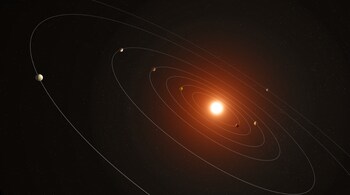
In a groundbreaking revelation, NASA has announced that astronomers have discovered a system (named Kepler-385) of seven blazing planets, each one larger than Earth and bathed in more radiant heat than any planet in our solar system, encircling a Sun-like star about 10% larger and 5% hotter than the Sun.
"A system of seven sweltering planets has been revealed by continued study of data from NASA’s retired Kepler space telescope: Each one is bathed in more radiant heat from their host star per area than any planet in our solar system. Also unlike any of our immediate neighbors, all seven planets in this system, named Kepler-385, are larger than Earth but smaller than Neptune," NASA said.
"At the center of the Kepler-385 system is a Sun-like star about 10% larger and 5% hotter than the Sun. The two inner planets, both slightly larger than Earth, are probably rocky and may have thin atmospheres. The other five planets are larger – each with a radius about twice the size of Earth’s – and expected to be enshrouded in thick atmospheres," NASA also wrote.
The discovery is a result of meticulous analysis of data obtained by NASA's retired Kepler space telescope. This pivotal breakthrough is detailed in the paper titled “Updated Catalog of Kepler Planet Candidates: Focus on Accuracy and Orbital Periods,” with the lead author being Jack Lissauer, a research scientist at NASA’s Ames Research Center.
Also Read: All about NASA-ISRO earth-observing NISAR satellite
“We’ve assembled the most accurate list of Kepler planet candidates and their properties to date,” said Jack Lissauer, a research scientist at NASA’s Ames Research Center in California’s Silicon Valley and lead author on the paper presenting the new catalog. “NASA’s Kepler mission has discovered the majority of known exoplanets, and this new catalog will enable astronomers to learn more about their characteristics.”
Also Read: NASA's SpaceX 29th CRS mission carries science to Space Station on Nov 9
Kepler's legacy: Unveiled 4,400 potential planets
Kepler’s primary mission of planet-hinting ended in 2013, followed by its extended mission, K2, until 2018. It unveiled that our galaxy hosts billions of hidden exoplanets (planets that are beyond our own solar system), potentially suitable for life. After the mission said there are more planets than stars, the enormous amount of Kepler data is being continuously analyzed by scientists. The catalog produced from this data contains almost 4,400 planet candidates, with over 700 of them existing within multi-planet systems. Among these discoveries is the Kepler-385 system.
Discover the latest Business News, Sensex, and Nifty updates. Obtain Personal Finance insights, tax queries, and expert opinions on Moneycontrol or download the Moneycontrol App to stay updated!





