

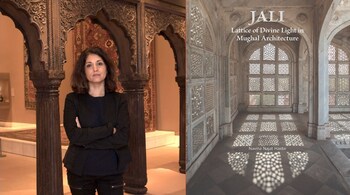
Art historian Navina Najat Haidar speaks to us about her new book Jali: Lattice of Divine Light in Mughal Architecture (Mapin, 2023). She is the Nasser Sabah al-Ahmad al-Sabah Curator in Charge of Islamic Art at the Metropolitan Museum of Art in New York City. Edited excerpts from an interview:
What do you find most exciting about the jali as a form?
When jalis are activated by the effect of light they come into their full visual and metaphorical potential. The dappled patterns of light and shadow that are created around a shrine or tomb are aesthetically powerful and also speak to the symbolism of light itself, which bears many meanings and allusions in Mughal architecture. These include references to ideas of divine illumination in Sufism and notions of wonder conveyed by the “dialectic potential of the jali to dissolve matter”, as Ebba Koch has so well expressed.
Which jalis took your breath away when you first saw them?
I was struck by the jalis of the Deccan, especially the calligraphic ones in arches surrounding the 17th century tomb of Sultan Ibrahim ‘Adil Shah II. These are pierced Qur’anic verses in a dark stone, probably basalt. Unlike the rest of the tomb which is largely carved in relief, these are pierced so that light passes through the letters in an openwork technique that is normally only achieved on smaller objects and with more malleable materials.
The marble jalis at the shrine of Sheikh Salim Chishti, erected in the late 16th century, have been mentioned in Mughal chronicles and have captured the attention of modern photographers and artists for their diaphanous splendour. They serve the pilgrims who come to visit the saint and find themselves in a special space with both meditative and inspirational qualities created by the filtered light.
I also admire the imagination behind modern jalis such as those in L’institut du monde arabe, Paris, by architect Jean Nouvel and team. On the façade we see 240 mashrabiyya screens made of metal alloy displaying traditional patterns of “Arab geometry” with apertures that mechanically operated by photoelectric cells to open and close like a clock as the day progresses.
What made you conceive this volume as an anthology with multiple voices instead of one authoritative narrator? Why did you choose these contributors for the essays?
The other authors are scholars or specialists in different aspects of art, architecture and ornament. Their wonderful contributions allow us to appreciate the jali feature from the point of view of early history (George Michell), symbolism and philosophy (Ebba Koch), patronage and craftsmanship (Mitchell Abdul Karim Crites), and the artistic imagination (James Ivory). We also had fun with the topic – publishing some wildly imaginative jalis such as those designed by Stuart Cary Welch – one with ecclesiastic cruciforms and another with spaghetti-like curves. We included a very special jali made daily of fresh jasmine buds as part of a temple seva of the photographer Abhinav Goswami, who is a trained temple priest. Just a few mentions of the variety and possibilities of this artistic language.
What are the stylistic differences and similarities between jalis in temples and mosques?
In the architecture of the Gujarat sultanate, jalis were a prominent feature of mosques and shrines and closely resembled those seen in late medieval Jain and Hindu temples of the same region. Their shared style was an openwork grid of squares, each containing a separate geometric motif or an auspicious symbol, such as a floral head or medallion. The grid form was probably based on an ancient timber style, later translated into stone and the symbols were drawn from varied sources including nature motifs, textile-like designs or abstract geometric forms — all very inventive and quite dazzling. When such pierced walls in temples were adapted into mosques, such as the 1333 Hilal Khan Qazi Mosque in Dholka (Gujarat), they assumed much greater prominence and importance, and also added a line of mihrab-niche openings at top, as a subtle addition to the otherwise almost unaltered pattern. Over time of course styles evolved, and continued to be shared and exchanged.
What were the aesthetic, political, spiritual, and pragmatic reasons that made jalis an important feature of Mughal architecture? Which royals were their foremost patrons?
Jalis were not more important than any other feature in Mughal architecture, which also contains wonderful carving, inlay work (parchin kari or pietra dura), wall painting, gilding and much more. There is a great deal to say about each one of these individual features, crafts and aspects of decoration and ornament which harmonize together to form the perfection of the Mughal vision. Jalis were carved and positioned in such a way as to filter the light as part of a visual and metaphorical language of light in Islamic architecture more broadly as well as the specific idea of nur-i ilahi or light as an attribute of divinity. We see this in the jali walls that surround the central grave markers in the Taj Mahal inner sanctum. This octagonal screen enclosure is thought to originally have been created in gold-enamel, probably designed by the polymath goldsmith, lapidary and poet Saida Gilani, but replaced in 1643 by the carved marble organic trellis we see now, inlaid with flowers in pietra dura. On full moon nights, the moonlight comes into this chamber through the jalis and covers the cenotaphs with a heaven-sent canopy of light and shadow.
Nur Jahan was a particularly brilliant patron of this art form. The upper storey of the tomb she built for her parents — Itimad ud daulah and Asmat Begum — in 1628, is a space of dappled and filtered light that lifts the cenotaphs into an almost celestial zone because of the effect of the light filtering through the jali walls across a floor inlaid with arabesques.
To what extent has the tropical climate in India played a role in the evolution of jalis?
The heat and strong sun no doubt played an important role in the development of the jali art form. Practically, jalis protect from the glare of the sun in the day and also create the movement of air. But they also work best aesthetically in the tropical climate of south Asia.
How can jalis be used today as a means of climate adaptation? Which cities could benefit from incorporating jalis in modern buildings? In what conditions should jalis be avoided?
The Gandhian architect Laurie Baker was one among others who adapted this feature to modern buildings, keeping in mind the issues of climate, environment and sustainability. Many of his structures were created with a skin of pierced brickwork which cleverly brought in light and cooling air. The book has a chapter on modernity and outlines some of the interesting and important developments in this area. In terms of benefits – it is pretty obvious that there has to be a rethink of architectural approaches for reasons of sustainability in almost every part of the world, from materials to design features. Especially in south Asia which is projected to have a dangerous rise in temperatures and is already over-heated.
Earlier, jalis were made of sandstone, marble, basalt, wood and iron. What other materials are being explored today, keeping sustainability in mind?
The examples of modern jalis in the book include those executed in ceramic, brink, stucco and other materials. Each one has its pros and cons from the sustainability point of view. I hope this opens up a discussion on the subject by professional architects and designers who face the challenge of designing for an overheated planet. A great deal can be learnt from craftspeople and villagers and the organic, natural materials used by them. Equally there are new technologies and breakthroughs in materials that could be considered. What it seems we need to evolve beyond are the concrete jungles of the 20th and early 21st centuries.
Discover the latest Business News, Sensex, and Nifty updates. Obtain Personal Finance insights, tax queries, and expert opinions on Moneycontrol or download the Moneycontrol App to stay updated!





