

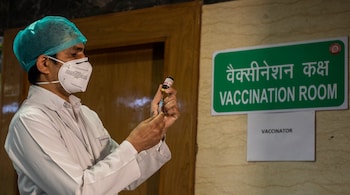
Serum Institute's second COVID-19 vaccine, Covovax, is likely to go into phase-3 trial later this month. Serum Institute has partnered with Novavax to develop the second coronavirus vaccine.
The Data Safety Monitoring Board has reviewed the safety data of the phase-2 trial, which comprised of 200 participants, and has given its recommendation, the Indian Express reported.
Track this LIVE blog for latest updates on coronavirus pandemic
The Drugs Controller General of India (DGCI) has also given its approval for the phase-3 trial, the report said.
Serum Institute is conducting the trials in collaboration with the Indian Council of Medical Research (ICMR).
Dr Abhijit Kadam, coordinating principal investigator from ICMR-National AIDS Research Institute of the trial, said that tentatively phase-3 should start by mid-May.
Read | Covid vaccine production and availability: What we know so far
"There are 19 sites across the country, four of them in Pune. Researchers across these sites said the process of recruiting volunteers for the larger phase-3 trial will begin soon," he said, as quoted by the newspaper.
The ICMR and SII are jointly performing a phase-2/3 observer-blind, randomised, controlled study to determine the safety and efficacy of the Covovax vaccine.
Covovax has been developed by US-based Novavax. It has signed a pact with SII, wherein the latter would produce about 1 billion doses of Covovax for supply to India and other countries.
Read: When should you get hospitalised? Health Ministry lists signs and symptoms
The Novavax vaccine, which uses different technology from the doses already widely licensed around the world, is a protein-based vaccine engineered from the genetic sequence of the first strain of the coronavirus.
It can be stored at a temperature between 2 and 8 degrees Celsius (35 - 46.4 degrees Fahrenheit).
Earlier, SII CEO Adar Poonawalla had said that the firm plans to launch the vaccine by September.
"Covovax trials finally begin in India; the vaccine is made through a partnership with Novavax and Serum Institute of India. It has been tested against African and UK variants of COVID-19 and has overall efficacy of 89 percent. Hope to launch by September 2021," Poonawalla has said in a tweet in March.
Click here for Moneycontrol's full coverage of the COVID-19 pandemic
Discover the latest Business News, Sensex, and Nifty updates. Obtain Personal Finance insights, tax queries, and expert opinions on Moneycontrol or download the Moneycontrol App to stay updated!





