

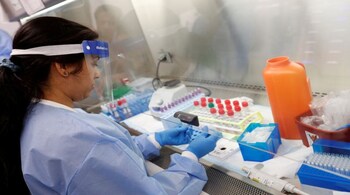
While the cases of COVID-19 are rising, the capacity utilisation levels of private diagnostic laboratories for COVID-19 testing remains less than 30 percent, according to a study conducted by the NATHEALTH, the industry body that represents private healthcare providers.
The study surveyed 50 private laboratories across 13 Indian states to explore ways to enhance testing in private sector labs.
The surveyed labs are currently working only single shifts, doing cumulative 5,000 RT-PCR tests per day with 17 labs doing less than 100 tests per day and 6 labs not doing any testing at all.
"A mere 30 percent utilisation of private labs also indicate demand flow as a challenge to enhance testing. The current testing regime prioritises demand flow to public labs with only excess demand flowing to private labs," the study said.
The current testing capacity in India stands at 150,000-170,000 tests per day with the public sector capacity at 110,000 tests per day and private sector capacity at 60,000 tests per day.
Track this blog for latest updates on the coronavirus outbreak
For instance, Maharashtra, which has the highest number of cases, has a testing capacity of 4,600 tests per shift in private sector, but it currently stands at only 1,450.
Currently, India is conducting 100,000 tests per day. A large portion of this is driven by government labs, which conduct around 75,000 – 80,000 tests, while private sector conducts 15,000 – 20,000 tests per day.
Private labs with support from central and state governments can quickly ramp up testing up to 4-6 times with double shifts.
Lab operators also mentioned significant on the ground operational issues. Around 56 percent of the survey respondents face logistics challenges which can be solved by sample flow between districts and states to ensure better utilization. 54 percent face difficulties with guidelines and procedures that may be solved by standardisation of forms and simplified approval processes for sample collection. Around 24 percent face pricing and commercial solution for which lies in expedited payments to tide over immediate liquidity challenges and consolidated procurement of consumables and kits.
NATHEALTH said improving existing capacity utilisation to 80 percent will increase testing to 14,000 tests per day, assuming one-shift operation is in place. Additionally, increasing shifts to 2 will increase testing by 30,000 tests per day.
Follow our full coverage of the coronavirus outbreak here
Discover the latest Business News, Sensex, and Nifty updates. Obtain Personal Finance insights, tax queries, and expert opinions on Moneycontrol or download the Moneycontrol App to stay updated!





