

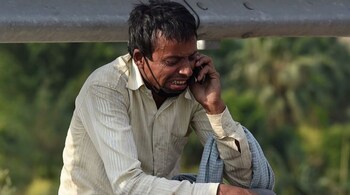
Rampukar Pandit became the face of India's migrant tragedy with his photograph speaking on the phone on a Delhi roadside. The construction worker is now back home in Bihar, broken at not being able to meet his son before he died and despairing about the future.
"We labourers have no life, we are just a cog in the wheel, spinning continuously until we run out of life,” said the man, his name unknown but his face by now familiar to many thousands of people across the nation.
The construction labourer, who worked at a cinema hall site in Delhi, was spotted weeping uncontrollably as he talked on the phone by the side of the Nizamuddin Bridge in Delhi by PTI photographer Atul Yadav earlier this week.
The powerful image of the distraught man, struggling to reach home in Begusarai, almost 1,200 km away during the nationwide lockdown, was widely shared across all media, becoming a defining image of the trauma of lakhs of migrant labourers stranded away from home. The photograph resulted in help being provided to him to reach his home in Bihar.
When the photograph was taken, the 38-year-old - now at a quarantine centre in a village school on the outskirts of Begusarai - said he was anguished at the thought he might not get home on time to see his baby.
Shortly after the photograph had been taken on May 11, his son died.
"My son, who had not even turned one-year-old, died and a bolt of lightning hit me. I pleaded to police authorities to let me go to my home but none helped," he told PTI over the phone.
"One policeman even said, ‘Will your son become alive if you go back home. This is a lockdown, you cannot move.' This is the kind of reply I got from them."
A woman in Delhi and a photographer - he did not know Yadav's name - were his saviours, he said.
"I was sitting there on the roadside, exhausted and just thinking of ways to reach home. A journalist came and asked why I was so upset and tried to help me by taking me in his car, but the police did not allow him. A woman then came and made some arrangements...she was like my 'mai-baap' (parents)," Rampukar said.
He had been stuck at Nizamuddin Bridge for three days before help arrived.
"The woman gave me food, Rs 5,500 and also booked my ticket in the special train, and that's how I was able to reach home," Rampukar said.
"The rich will get all the help, getting rescued and brought home in planes from abroad. But we poor migrant labourers have been left to fend for ourselves. That is the worth of our lives," he said.
"We labourers don't belong to any country ('hum mazdooron ka koi desh nahi hota')."
Rampukar, who also has three daughters, said he had named his son Rampravesh, as his name also has a Ram in it.
“Will a father not want to go home and even mourn the death of his son, with his family?"
Rampukar, who moved to Delhi's Uttam Nagar during his childhood along with his uncle to eke out a living, still hasn't managed to meet his family.
"I reached Begusarai from Delhi by train a couple of days ago. We were then taken to a nearby screening facility and kept there overnight. In the morning, a bus took us to a school just outside the Begusarai town, and since then I am here," he said.
He still doesn't know when he will be reunited with his family.
"My wife, who is unwell, and my three daughters, Poonam (9), Pooja (4) and Priti (2) are waiting for me. The wait just doesn't seem to end," he said.
Fortunately, he has found a friend in his hour of grief.
Ghanshyam Kumar, 25, his neighbour in his village Bariarpur, is also quarantined in the same school.
"I work as a labourer in Kanpur, and reached the UP-Bihar border after taking a bus, and from there a train. At the station, I recognised Rampukar. Grief tears us apart, and sometimes unites us too," he said.
Yadav, the photographer who covered the 2004 tsunami in the Andaman and Nicobar islands, the 2005 earthquake in Jammu and Kashmir, told Firstpost that he had “never seen anything like” the ongoing coronavirus crisis before.
“It is a very different sort of challenge,” he said.
[With PTI inputs]
Discover the latest Business News, Sensex, and Nifty updates. Obtain Personal Finance insights, tax queries, and expert opinions on Moneycontrol or download the Moneycontrol App to stay updated!





