

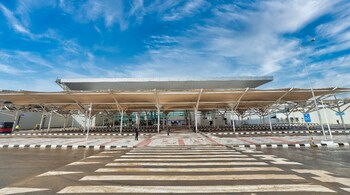
In a bid to meet the increasing demand in the aviation sector, the central government will spend Rs 25,000 crore in the next five years to develop new and existing airports across the country, Minister of State in the Ministry of Civil Aviation, VK Singh said in a written reply to a question in the Rajya Sabha on March 14.
As part of the plan, the Airports Authority of India (AAI) will spend Rs 25,000 crore in the next five years to construct new terminals, expand and modify existing terminals, expand or strengthen existing runways, aprons, Airport Navigation Services (ANS) infrastructure, control towers and technical blocks.
The government is also looking to invest Rs 36,000 under public-private partnerships for the development of new greenfield airports across the country. So far 'in-principle' approval has been given to set up 21 greenfield airports across the country.
Out of the aforementioned 21, eight airports at Sindhudurg and Shirdi in Maharashtra, Durgapur in West Bengal, Pakyong in Sikkim, Kannur in Kerala, Orvakal in Andhra Pradesh, Kalaburagi in Karnataka and Kushinagar in Uttar Pradesh have been operationalised, the government said.
As part of its regional connectivity scheme (RCS), Ude Desh ka Aam Nagrik (UDAN), the government has operationalised 403 routes connecting 65 airports, including 8 heliports and 2 water aerodromes.
AAI has further identified 154 airports including 14 water aerodromes and 36 helipads so far to be developed under UDAN for the operation of RCS flights.
Discover the latest Business News, Sensex, and Nifty updates. Obtain Personal Finance insights, tax queries, and expert opinions on Moneycontrol or download the Moneycontrol App to stay updated!





