

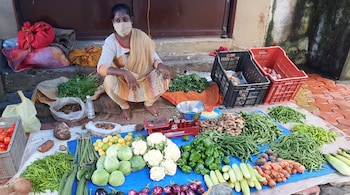
Stimulus packages, loan moratorium, liquidity injection and then there are vegetables. From the office district of Fort to the northern suburbs around Borivali in the north-west, vegetable sellers can be seen in every street of Mumbai these days.
The government and the Reserve Bank of India have stepped in on several occasions to support the economy as the coronavirus outbreak wrecked businesses, ate up jobs and destroyed livelihoods.
But it is potatoes, onions and tomatoes spread out on plastic sheets, displayed on rickety wooden platforms, ferried in vans or carried on heads in cane baskets that have come to the rescue of hundreds of thousands of people in Mumbai and across the country.
“After the lockdown, we stayed home for a month and a half. That's the most we could survive without earning daily. The only opportunity available was selling vegetables," said Premchand Gupta, a 50-year old resident of Shivaji Nagar, a lower middle-class neighbourhood in a largely affluent Borivali.
For 15 years, Gupta had been driving an auto rickshaw and his wife worked as domestic help in nearby high-rises. The two earned enough to support their family of four but then the virus struck and the lockdown followed. Going out for work was out of the question.
Not just rickshaws, Mumbai’s streets have been missing its favourite street food— vada pav. Stalls and carts selling the snack vanished overnight as Mumbai. So did hawkers and vendors as the lockdown kicked in and India’s financial capital battled one the worst outbreaks in the country.
In the last few weeks, the situation has improved but at its peak, the city was reporting 2,000 cases a day, forcing the government to convert stadiums, parks and other large public spaces into makeshift hospitals.
The city that never slept now had a 9pm. While white-collar workers moved on to work-from-home mode, drivers, domestic helps, shop hands, construction workers and all others in the informal sector, one of the biggest employers in the country, found themselves jobless.
Vegetables saved them.
Why vegetables?
The nationwide lockdown that began March 25 brought all economic activity to a standstill and its effects were widespread and devastating.
Around 12.15 crore jobs were lost in April and 9.12 crore of these were those of hawkers and daily-wage labourers, private think tank Centre for Monitoring Indian Economy (CMIE) said in a report.
As many as 1.44 crore of these jobs revived in May, 4.45 crore in June and 2.55 crore in July but a yawning gap remains. Around 7.8 crore entrepreneurs also declared themselves unemployed from April to July, media reports said, citing CMIE’s latest report released in August.
The formal sector, too, has been hit. As many as 50 lakh salaried people lost jobs in July, taking to 1.89 crore the number of people left jobless since April, the report said.
Also read: 10.8 million and counting: Take a look at how many jobs Covid-19 has wiped out
With their jobs gone, thousands of people left cities for their home towns. There were many more who stayed back or didn’t have a home town to go back to.
Categorised as essential items along with milk, medicines and groceries, there were no restrictions on selling vegetables.
Premchand Gupta grabbed the opportunity. He set up a small platform outside his house, which is on a busy road in Borivali, and started selling vegetables.
His earnings are barely enough for the family but in the absence of any other option, vegetables have been a lifesaver.
Not too far away, Rekha sits on a pavement in front of neatly arranged small heaps of cauliflower, cabbage and other vegetables.
She used to work in a small garment unit but the factory didn’t open even after lockdown restrictions were eased. Selling vegetables isn't very profitable but it will have to do for now.
“My husband works at a construction site and he returned to work mid-June. As he doesn’t earn enough, I used to chip in. With the factory closed, vegetables provide some relief and I can also take care of my son,” she said.
Every morning, Rekha and Premchand head to the nearby Dahisar Market, where wholesalers bring their produce. They spend between Rs 1,000 and Rs 2,500 to buy their daily supply of vegetables.
Mumbai has several such markets and hundreds of sellers go there to pick up fruits and vegetables that are grown in farms around Mumbai.
Selling vegetables requires no special skills nor does it need a lot of money and is pandemic-proof.
Before the outbreak, a group of vendors would set in a row along a busy road, close to a train station or a bus stop but these clusters are not allowed anymore to avoid crowding.
The sellers have been forced to spread out but it has made it easy for customers who don’t have to venture too far.
Track this LIVE blog for all the latest updates on coronavirus pandemic
Vegetables are everywhere. Shops that used to sell T-shirts and accessories now sell vegetables. Grocers, too, have started selling potatoes, onions, and green vegetables.
Vegetable vans and mini-trucks are a common sight in the city’s housing complexes. Their business shuttered, many small business owners have tied up with resident welfare associations to bring produce straight to housing complexes.
The arrangement works well for both sides—vehicle owners get business and residents can shop within the safety of their premises, reducing chances of contracting the virus.
“We stop for an hour in each locality and visit some residential complexes regularly,” a van seller, who didn’t wish to be identified, said.
Vans and trucks allow them to buy in large quantities and drive to bigger wholesale markets where rates are more competitive.
Are people eating more vegetables?
Yes and no. Yes, because the demand for vegetables has undoubtedly gone up. No, because the total consumption hasn't gone up.
Wholesalers say their earnings have remained constant. There was a marginal increase in prices in the early days of lockdown due to transportation and supply problems but it was temporary. Instead of selling stock to establishments and consumers directly, they were now selling everything to people like Gupta and Rekha.
Households are buying more vegetables but there has been a big drop in demand from commercial establishments like neighbourhood eateries, restaurants and hotels.
Most eateries and restaurants are open now, but the business is barely a fifth of what it used to be. Even the most loyal customers are staying away, restaurant owners say.
In the early days of lockdown, students, office-goers living alone or sharing apartments, who accounted for the bulk of customers, stopped ordering food.
Outside food wasn't thought to be safe and almost everyone was cooking. Those who couldn’t, they turned to packaged food, which saw a surge in demand.
Anvit Sharma used to order out at least once in the day. “During the lockdown, I was forced to cook. Vegetables are a bare minimum requirement, so I buy my stock once a week when a tempo comes to our society complex,” the 23-year old musician who lives in Andheri said.
For many, the shift also means savings. Several people that Moneycontrol spoke to agreed on one thing: cooking at home was far more economical than ordering out.
And it makes a lot of sense when layoffs and salary cuts are the order of the day.
Overall consumption of vegetables hasn't altered dramatically but consumers have. As more people eat at home, more shop for vegetables, which is good for sellers.
This monsoon season, Maharashtra and neighbouring states have got plenty of rain and areas around the city have enough water for farming, which holds out hope for a battered economy.
The Indian economy shrank 23.9 percent during the April-June quarter, the sharpest drop in 41 years, compared to a growth of 8.1 percent in the same quarter last year.
In a set of bleak numbers, the agriculture sector was the only bright spot. Agriculture, forestry and fishing reported 3.4 percent growth in the quarter, up from 3 percent in the same period last year.
And, it is not just Mumbai, across the country—from the national capital of Delhi to IT hubs of Gurugram and Bengaluru to Ahmedabad—vegetables are ensuring that hundreds of thousands of people don’t sleep on an empty stomach.
At a time like this, vegetables are not just healthy for the body but perhaps for the economy as well.
(Shivam Vahia writes on technology, aviation, and mobility.)
Discover the latest Business News, Sensex, and Nifty updates. Obtain Personal Finance insights, tax queries, and expert opinions on Moneycontrol or download the Moneycontrol App to stay updated!





