

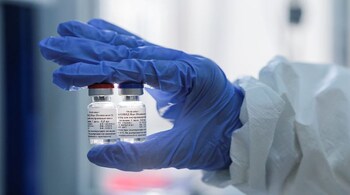
The Drug Controller General of India (DCGI) on April 12 approved the emergency use authorisation of Russia's Sputnik V COVID-19 vaccine.
Sputnik V vaccine will be the third COVID-19 inoculation to be made available in India.
Russian Sovereign Wealth Fund RDIF said the Sputnik V vaccine will be rolled out in India by the end of April or early May.
Sputnik V, developed by the Gamaleya Research Center for Epidemiology and Microbiology, Moscow, and bankrolled by Russian sovereign fund RDIF, became the first registered COVID-19 vaccine in the world.
Here is the comparison on how Sputnik V vaccine stacks up against the two available indigenous vaccines, Serum Institute of India’s (SII) Covishield and Bharat Biotech's Covaxin.
Platform
The Sputnik V vaccine is similar to SII's Covishield, as it is based on the adenovirus vector platform. Sputnik V uses two different human adenoviruses (rAd26 and rAd5) as vectors for two doses, while Covishield uses a Chimpanzee adenovirus for two doses.
The rAd5 adenovirus has been used in Ebola vaccine. The second vector, rAd26, is a rarer adenovirus. This, the Russians claim, stimulates a stronger immune response.
Covaxin is based on the more established inactivated whole virion platform. Analysts say that use of two different adenovirus vectors may increase the complexity and cost of manufacturing for Sputnik V vaccine.
Safety
The data from clinical trials of Sputnik V suggest that no serious adverse events were detected. Most effects were mild, with just over half experiencing pain at the injection site.
Both Covishield and Covaxin are also safe vaccines with mostly mild-to-moderate side effects. Covishield - which is nothing, but the AstraZeneca-Oxford University vaccine - is facing some recent controversies for instances of rare blood clotting.
But the World Health Organisation (WHO) and the European Medicines Agency (EMA) have said that the benefits of using the vaccine outweigh the risks. The AstraZeneca vaccine, approved in highly regulated countries, has gone through a lot of scrutiny on safety.
Efficacy
The efficacy of Sputnik V is 91.6 percent, as confirmed by the data published in the Lancet. It is one of only three vaccines in the world with an efficacy of over 90 percent. Sputnik V must be given in two doses at 21 days interval.
Covishield efficacy increases to 82.4 percent when the dosing interval is stretched to 12 weeks or more and Covaxin interim data indicates efficacy of 81 percent at a four-week interval between two doses. All the three vaccines have been tested on the local population.
All the three vaccines provide full protection against severe cases of COVID-19 that involve hospitalisation and high risk of death.
Cold storage
Sputnik is available in two forms; liquid, to be stored at -18°C and lyophilised (freeze dried), to be stored at 2°C to 8°C. The lyophilised version would be more suitable for Indian cold chain requirements. Both Covishield and Covaxin are stored at 2°C to 8°C or normal refrigeration temperatures.
Price
The cost of the vaccine would be a major consideration for uptake of the vaccine. RDIF announced that the Sputnik V vaccine would be priced at less than $10 per dose.
The prices are expected to come down as production volumes expand. The RDIF chief indicated that he is in discussion with the government about the price of the vaccine.
SII's Covishield and Bharat Biotech's Covaxin are offered at Rs 150 per dose, making them the most affordable vaccines anywhere in the world.
Production
RDIF indicated that over 850 million doses of Sputnik V are going to be produced in India annually, which is sufficient to vaccinate more than 425 million people around the world.
If Sputnik V meets the production target - it will have the highest production capacity compared to Covishield and Covaxin. SII is producing 70-100 million doses per month, while Bharat Biotech is trying to ramp up Covaxin to 50-60 million doses per month. India needs 10 million doses per day.
Approvals
Sputnik is a widely used vaccine. About 60 countries, including India, have approved the vaccine for emergency use. SII's Covishield is also widely used and has been approved by the UK, EU, and the WHO, all of whom have cleared the vaccine for use. Covaxin has been approved in India and Mexico, but the vaccine is exported to many countries.
Discover the latest Business News, Sensex, and Nifty updates. Obtain Personal Finance insights, tax queries, and expert opinions on Moneycontrol or download the Moneycontrol App to stay updated!





