

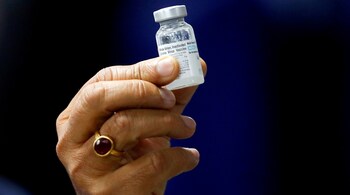
Earlier this week, the Indian Council of Medical Research (ICMR) announced that Covaxin has neutralised multiple variants of SARS-CoV-2, including the double mutant strain called B.1.617, which has become a cause of concern due to its high transmissibility.
B.1.617 first identified in Maharashtra, has now spread to many states and several other countries.
ICMR said Covaxin is found to work against the UK and Brazil variants.
The Centre for Cellular and Molecular Biology (CCMB), which is a CSIR laboratory, announced that Serum Institute of India’s (SII) Covishield effectively works against the double mutant strain as well.
What does this mean for vaccines? The two announcements by government research institutions come as a relief, because scientists feared that the double mutant or B.1.617 strain of SARS-CoV-2 virus may dodge the immune system and render vaccines ineffective.
B.1.617 is the outcome of mutations in the viruses’ spike proteins, which allow it to avoid being bound by antibodies produced after vaccination or natural infection.
Now, there is strong evidence that both the vaccines are working against this mutant.
How do scientists figure out whether vaccines are working on variants?
First, researchers need to isolate and grow multiple variants of concern of SARS-CoV-2 virus. For instance, ICMR-NIV has isolated and cultured B.1.1.7 (the UK variant), B.1.1.28 (Brazil variant), B.1.351 (South Africa variant) and double mutant or B.1.617 (Indian variant).
Then researchers collect vaccinated sera samples from people who have been inoculated, and the convalescent (prior infection) sera. Vaccinated and convalescent sera will be rich in antibodies or neutralising titers. They will see how the antibodies or neutralising titers in the vaccinated and convalescent sera fared against the new variants and check whether there are any escape mutants. The early results used in vitro neutralization assay show that both convalescent (prior infection) sera and Covishield vaccinated sera offer protection against the B.1.617 variant
How are the new mutants detected?
Genomic sequencing can help in not just detecting new variants, but also map the transmissibility and their origin.
India is keeping a close watch on possible new variants, both from incoming travellers from overseas and also domestically.
To sequence the viral genome, the government has set up Indian SARS-CoV-2 Genomics Consortium (INSACOG) Labs. Ten laboratories - NIBMG Kolkata, ILS Bhubaneswar, NIV Pune, CCS Pune, CCMB Hyderabad, CDFD Hyderabad, InSTEM Bengaluru, NIMHANS Bengaluru, IGIB Delhi and NCDC Delhi - are part of this consortium.
Samples of all inbound international passengers, who test positive to COVID-19 on screening at arrival, are now sent for genomic sequencing. All positive samples from people who are either participating in vaccine trials or have been vaccinated and all positive samples from people with a prior history of infection and confirmed re-infection, are also included.
For general surveillance - the government randomly collects samples of five percent of positive COVID-19 cases across India. Samples from metro cities, COVID clusters and new clinical symptoms are given priority for purposes of sequencing.
How do the government and public respond to variants?
The government should scale up genomic sequencing to keep a tab on the emerging variants. Cases of vaccine breakthrough infections, new infections and new clinical symptoms need to be sequenced.
Containing mutants require the same epidemiological and public health response of increased testing, comprehensive tracking of close contacts, prompt isolation of positive cases and contacts as well as treatment as per National Treatment Protocol defined by the ICMR. Public should adhere to COVID-19 appropriate behaviour such as masking, maintaining social distance and hand hygiene.
Discover the latest Business News, Sensex, and Nifty updates. Obtain Personal Finance insights, tax queries, and expert opinions on Moneycontrol or download the Moneycontrol App to stay updated!





