

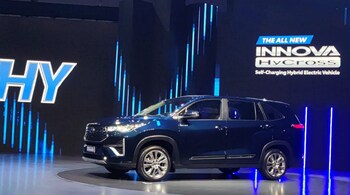
The arrival of the Toyota Innova Hycross marks the fourth major strong-hybrid launch this year, firmly establishing the fact that, across segments, hybrids seem to be the preferred alternative, at least to diesel vehicles.
The recently launched Maruti Suzuki Grand Vitara alone sold 8,000 units in October, despite Maruti Suzuki being something of a novice in the mid-size SUV segment.
The Hycross, much like the Honda City hybrid and the Toyota Hyryder, features only a petrol engine as an alternative, with the older Innova Crysta left to grapple with Toyota’s agricultural, albeit popular diesel.
With a government adamant on lowering oil imports, and an electric vehicle (EV) ecosystem that’s yet to take flight, just where do hybrids feature in the larger scheme of things? Will hybrids serve as a stop-gap measure till there’s greater price parity between ICE cars and EVs, along with a better infrastructure? In all likelihood, yes. But the presence of hybrid powertrains in brand-new models should clue us into just how long manufacturers think it’ll take to get to an EV-dominant future.
At present, the government appears to be at loggerheads with brands like Maruti Suzuki, Toyota, and Honda, all of whom have argued in favour of reducing the GST slab for both small and large hybrids. The government charges 43 percent GST on large hybrids and 28 percent on small hybrids, treating them on par with their petrol and diesel-powered counterparts. Given the added cost of the battery components, hybrids have been rendered unaffordable in a bid to push EVs.
But with rising fuel costs, customers are preferring to pay the additional cost for a hybrid instead of a cheaper petrol version, given that in the city, a strong hybrid can be driven extensively on electric power alone.
Hybrid cars: Major benefits and drawbacks
In India, the term hybrid has been supplanted by “strong hybrid,” which is used to define a vehicle with a lithium-ion (or nickel-hydride) battery, that supplements the power of the ICE (internal combustion engine) with battery power.
The distinction is made due to cars featuring starter motors qualifying as “mild hybrids” in order to avail of the marginal GST difference between ICE and hybrids. Mild hybrids fall under the same GST slab as ICE vehicles. Given that most modern hybrids feature lithium-ion batteries, they are expensive, since the battery components are all imported. This makes it particularly difficult to have a hybrid in the sub-4 metre, entry-level category. With EVs like the Tata Tiago EV already hacking away at the price barrier, it won’t be long before budget entry-level EVs will be plying the streets, present in a space where hybrids cannot compete. And although EVs aren’t going to be priced on par with the likes of the Maruti Suzuki Alto anytime soon, they will penetrate the lower end faster than hybrids. Because unlike hybrids, which still have a petrol engine and ICE powertrain components, EV running and ownership costs are far lower.
Hybrids have also failed to entice luxury car buyers, as evidenced by Lexus India not having had any major advantage over its European competitors. Despite the local assembly of its popular ES300h, Lexus has been unable to penetrate the luxury car market. This is largely because most of its models are imported and hence cost as much as cars belonging to a higher segment.
But it also points at hybrids not having the novelty factor possessed by EVs, which continue to attract buyers in the luxury segment. Right from Volvo XC40 Recharge to Mercedes-Benz EQS, luxury EVs have witnessed strong demand thanks to lower GST slabs helping ensure they are priced competitively compared to their ICE counterparts. For instance, Mercedes’ EQS 580 4Matic is priced lower than its S-Class.
Luxury EVs are also able to accommodate large battery packs which offer an extended range – the EQS 580, for example, offers roughly 650 km. This makes luxury EVs far more appealing than an ICE powertrain or its derivatives as the per km running cost is lower than that of a diesel (if only slightly, since charging a sub-100 Kwh battery pack isn’t an inexpensive proposition)
It should also be noted that the newly-launched slew of hybrid cars – the Honda City, the Toyota Hyryder, and the Innova Hycross — don’t have any territorial tussles with EVs. There is no all-electric sedan in the City’s segment, nor is there an EV SUV to compete with the Hyryder. Sure, you’ve got the Nexon EV Max and the MG ZS, but neither offer the size and practicality of the Hyryder and the Grand Vitara.
Thus far there’s no overlap between the two technologies and their segments to indicate a popular preference towards hybrids over EVs. Hybrids are popular in segments where the best-selling models in the past have featured diesel powertrains. This is also because diesels have been the preferred engine type for those travelling long distances on a regular basis. And long-distance transport continues to be the Achilles heel of EVs, especially at the lower and mid-range of the price spectrum.
Yet, despite there being no direct overlap, the battle lines are more clearly drawn than ever. The brands betting big on EVs and investing heavily believe hybrids can be bypassed. Tata Motors’ Passenger Car head Shailesh Chandra has gone so far as to say that hybrids are a stop-gap measure by manufacturers in order to meet CAFE (Corporate Average Fuel Economy) emission norms. These are norms imposed on a carmaker’s entire fleet, and not on an individual model.
On the other side are brands like Maruti Suzuki, Honda, and Toyota – the latter having been a global front-runner in hybrid technology – who consistently point out that market demand for EVs isn’t yet strong enough to justify their entry into the space. And therefore, for the time being, the government must extend the same tax rebates to hybrids that are being offered to EVs.
The rebate debate
The union government wanting to push EVs to reduce its oil import bill is a goal one can get behind. However, from a purely environmental POV, it makes sense to lower the GST bracket for hybrids, if not to 5 percent then to a point which puts them on par with EV prices. Ultimately leaving it to the consumer to decide whether they want the practicality and convenience of a go-anywhere hybrid with zero range anxiety, or the performative edge, ease of ownership, and low running costs that come with an EV.
Wanting to promote EVs and at the same time pushing for a higher ethanol blend in biofuels is a self-defeating concept, because the latter prolongs the use of ICE powertrains. Instead of manufacturers having to incorporate the mechanical changes that come with biofuel compatibility, they can focus on providing hybrid solutions, given that customers are far more likely to switch to EVs from hybrids than pure ICE models. When the charging infrastructure is sophisticated enough to obliterate range anxiety, and when battery prices come down, EVs will be the obvious choice.
But despite a parliamentary panel being set up to consider GST cuts for hybrids, not much is likely to develop on that front. Because if it were likely, brands would already be introducing plug-in hybrids as opposed to self-charging ones. Unlike self-charging hybrids like the ones available (Honda City eHEV, Toyota Hyryder, Toyota Camry Hybrid), plug-in hybrids come with a much larger battery – one capable of running on electric power alone for a good 100 km. But should you run out of range, the car can immediately switch to fossil fuel power. It’s truly the best of both worlds and is the technology most suited to the transition phase that India’s automotive sector is going through.
Discover the latest Business News, Sensex, and Nifty updates. Obtain Personal Finance insights, tax queries, and expert opinions on Moneycontrol or download the Moneycontrol App to stay updated!





