

The Kia Seltos has had a strong and sustained run in the Indian market. When it arrived in 2019, it did more than just find acceptance -- it reshaped the mid-size SUV segment almost overnight. That kind of early success is difficult to replicate, and even harder to sustain in a segment that has only grown more crowded with time.
Over the years, several rivals have entered the space, many with strong brand equity and frequent updates. Yet, the Seltos has managed to stay relevant. Part of that comes down to how broadly it has been positioned. It has appealed to younger buyers drawn by features and technology, as well as to more mature customers prioritising comfort and space. Multiple powertrain options have further widened its reach.
In many ways, the Seltos has been the backbone of Kia's India story.
Now, the company has brought in the second-generation version. And this is not a light update. We recently spent time driving the new Seltos, and here's how it stacks up in the real world.
Kia Seltos 2026 review: Design and dimensions
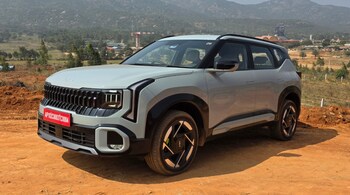
The new-generation Seltos is larger in every dimension that matters. It is now 95mm longer, measuring 4,460mm, and 30mm wider at 1,830mm. That makes it the longest and widest SUV in its segment. The wheelbase has also grown by 80mm to 2,690mm, which has clear implications for cabin space. Interestingly, overall height has been reduced by 10mm, while ground clearance has gone up by 10mm to 200mm.
Design, of course, is subjective. And Kia's designs have generally found favour with Indian buyers. The new Seltos adopts the brand's 'Opposites United' philosophy and introduces what Kia calls the digital tiger face. This includes ice cube LED headlamps with a dynamic welcome function, star map LED DRLs with integrated turn indicators, and connected LED tail lamps at the rear.
Compared to the outgoing model, which had a sharper and more conventional front-end, the new face is visually busier. The vertical grille slats expose more of what sits behind them, and that may divide opinion. From a practical standpoint, it is also the kind of grille that will demand a bit more effort to clean.
Flush door handles that extend automatically on sensing proximity are new, and they work as intended. The 18-inch alloy wheels look more aerodynamic, while the neon brake calipers add a bit of visual contrast. There is also an integrated rear spoiler with a hidden rear wiper, along with revised front and rear skid plates finished in dark gunmetal. Kia is offering the new Seltos in 10 monotone colour options, including two new shades -- Morning Haze and Magma Red.
Overall, the Seltos looks sportier than before without trying too hard to look rugged or butch. The added size gives it more presence, but it still feels proportionate.
Kia Seltos 2026 review: Interior, features and technology
The Seltos has always been strong on interiors, and the new generation takes that further. Step inside, and the cabin immediately feels more contemporary. Fit and finish are consistently good, and there is a generous use of soft-touch materials across key touchpoints.
Space is not an issue. Legroom, shoulder room and headroom are all ample, including for taller occupants. Seat comfort, both at the front and rear, is well judged.
The most noticeable addition is the 30-inch trinity panoramic display panel. It integrates the digital instrument cluster, infotainment system and climate controls into a single, continuous layout. This setup has been taken from the EV9, which is Kia's most expensive car. Screen clarity is excellent, and the interface responds quickly to inputs, with minimal lag while switching between menus.
Importantly, Kia has not gone all-in on touch controls. Physical buttons remain for certain key functions, and they are neatly integrated into the dashboard. They feel well-made and are easier to use on the move.
The comfort-focussed features have been expanded too. The driver gets a 10-way power-adjustable seat with power lumbar support and a relaxation function. Ventilated front seats are offered, along with a memory function that syncs the driver seat position with ORVM settings. There is also a welcome retract seat function that makes getting in and out easier.
Other features include a dual-pane panoramic sunroof, 64-colour ambient lighting, a Bose audio system with eight speakers, wireless smartphone charging, and rear sunshade curtains. Rear passengers also get recline-adjustable 60:40 split seats, along with Type-C charging ports at both the front and rear.
That said, a few decisions stand out. The auto-hold button is positioned on the centre console, while the electronic parking brake switch sits on the extreme right of the dashboard, next to the headlamp leveller. These two are usually grouped together. Kia says this has been done deliberately as a safety measure to prevent accidental engagement, especially by children.
Connectivity has been upgraded to Kia Connect 2.0, which now supports over-the-air updates and vehicle diagnostics. Wireless Android Auto and Apple CarPlay are available on supported variants.
There are also some omissions. A powered tailgate is not offered. One-touch up and down operation for all windows is limited to the driver's window. And while Kia offers ventilated second-row seats on the Syros, that feature has not made it to the Seltos. Several models (Tata Sierra and Maruti Suzuki Victoris) in the mid-size SUV space now get Dolby Atmos, which usually offers better audio quality than what you have in the Seltos.
Kia Seltos 2026 review: Platform and safety
Underneath, the new Seltos sits on Kia's global K3 platform, which makes its India debut here. The platform uses a higher proportion of high-strength steel and hot-stamped components, aimed at improving rigidity, crash protection and NVH levels.
Standard safety equipment includes a 24-feature package with six airbags, ABS, ESC, hill-start assist, a rollover sensor and rear occupant alert. The ADAS Level 2 suite brings 21 autonomous features, including forward collision warning, forward collision avoidance assist, lane keeping assist and smart cruise control with stop-and-go.
In use, the ADAS system works consistently. Lane markings are picked up reliably, even when they are not perfectly defined. Smart cruise control manages speed, braking and acceleration smoothly, though driver attentiveness is still required at all times. The Seltos also gets a blind view monitor, a 360-degree surround camera and side parking sensors, all of which help in everyday driving.
Kia Seltos 2026 review: Powertrain
The Seltos continues with three engine options. There is the Smartstream G1.5 naturally aspirated petrol producing 115PS and 144Nm, the Smartstream G1.5 T-GDi turbo-petrol delivering 160PS and 253Nm, and the 1.5-litre CRDi VGT diesel with 116PS and 250Nm.
Transmission choices remain broad. The naturally aspirated petrol is offered with a 6-speed manual and an IVT automatic. The turbo-petrol can be paired with a 6-speed iMT or a 7-speed DCT automatic, while the diesel gets a 6-speed manual and a 6-speed torque converter automatic.
We drove the Smartstream G1.5 T-GDi turbo-petrol paired with the 7-speed DCT.
From a standstill, there is a brief hesitation till about 2,000rpm. It is noticeable, but only in very specific situations. Once the car is rolling and you ease back onto the throttle, that lag largely disappears.
Beyond that point, the engine feels strong. Power builds quickly, and the Seltos gathers speed with little effort. Overtakes are dispatched cleanly, and triple-digit speeds come up without much planning. There is enough performance on tap to demand restraint, especially on open roads.
The 7-speed DCT complements this engine well in daily driving. It creeps forward smoothly in traffic, handles stop-go conditions without fuss, and shows no judder under gentle throttle inputs. Upshifts are unobtrusive when driving calmly, while kickdown responses are prompt when you ask for more. Paddle shifters are available, though the gearbox manages most situations effectively on its own.
One thing that does show up when driving harder is traction. On slightly uneven or broken surfaces, heavier throttle inputs can occasionally overwhelm available grip, leading to brief wheelspin. It is not alarming, but it does mean throttle inputs need to be measured when pushing the car.
There are three drive modes -- Eco, Normal and Sport. Each brings a noticeable change in throttle response and gearbox behaviour. Eco keeps things relaxed, Sport sharpens responses, while Normal offers the most balanced setup. Traction modes for Sand, Mud and Snow are also offered, though these could not be tested during our drive.
Kia Seltos 2026 review: Ride and handling
From behind the wheel, the Seltos feels easy to drive. The steering is light at low speeds, which works well in city traffic and tight spaces. However, as speeds rise, the steering does not gain weight as progressively as some drivers might expect. This remains the case even in Sport mode and slightly dulls feedback at higher speeds.
Ride quality benefits from the new platform. The suspension deals well with smaller road imperfections and keeps the car settled on typical urban roads. Sharper bumps and rough patches are felt more distinctly, but never to an uncomfortable extent.
Out on faster roads, the Seltos feels composed. Through sweeping bends, it holds its line well and does not require frequent steering corrections. Body movements are controlled, and the car settles quickly after lane changes. Braking performance is confidence-inspiring, with a progressive pedal that makes it easy to modulate stops.
Kia has also worked on refinement. Road noise remains well controlled at both city and highway speeds, contributing to a calmer cabin over longer journeys.
Kia Seltos 2026 review: Price and positioning
Bookings for the Seltos 2026 opened on December 11, with prices scheduled to be announced on January 2. The outgoing Seltos is priced between Rs 10.79 lakh and Rs 19.81 lakh (ex-showroom) and is currently available with year-end benefits of up to Rs 1.18 lakh.
The new Seltos is expected to be priced between Rs 11 lakh and Rs 20 lakh (ex-showroom), keeping it broadly in line with the outgoing model.
Kia Seltos 2026 review: Rivals
Among the rivals of the Kia Seltos 2026 are the new Tata Sierra, Hyundai Creta, Maruti Suzuki Grand Vitara, Maruti Suzuki Victoris, Toyota Urban Cruiser Hyryder, Mahindra Thar Roxx, Tata Curvv, Honda Elevate, Skoda Kushaq, Volkswagen Taigun and MG Astor.
Kia Seltos 2026 review: Verdict
The Seltos understands the Indian market very well. Hence, we do not think it has tried to reinvent a winning formula. Instead, it has enhanced the offerings in meaningful ways. The shift to a new platform, the addition of advanced safety features and a more tech-forward cabin make this a far more rounded package than before.
On the road, the Seltos remains easy to live with. The turbo-petrol and DCT combination delivers strong performance with decent ride quality and overall stability. That said, steering feedback at higher speeds could have been better, and the powertrain demands measured inputs when driven hard.
Taken as a whole, the Seltos now feels more complete and more mature. For buyers looking for a mid-size SUV that balances performance, comfort, quality, technology and safety without leaning too far in any one direction, the new Seltos makes a strong case.
Discover the latest Business News, Sensex, and Nifty updates. Obtain Personal Finance insights, tax queries, and expert opinions on Moneycontrol or download the Moneycontrol App to stay updated!





