

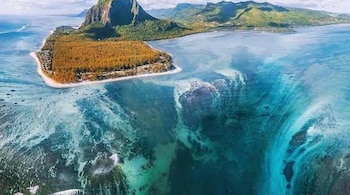
When most of us think of a waterfall, we picture something like Niagara or Victoria Falls. Water crashes over a cliff. There is spray, thunder and mist. The world’s largest waterfall, however, makes no sound that human ears can hear and cannot be seen from the surface at all.
It lies underwater.
The Denmark Strait cataract sits between Greenland and Iceland, where the cold waters of the Nordic Seas meet the warmer waters of the Atlantic Ocean. Unlike a river waterfall, this one is driven not by gravity pulling water over exposed rock, but by differences in temperature and density beneath the sea.
Cold water is denser than warm water. In the Denmark Strait, frigid, heavy Arctic water flows southward and encounters relatively warmer Atlantic water. Because it is denser, the colder water sinks sharply downward along the seafloor. That downward plunge forms what scientists describe as a submarine waterfall.
The scale is staggering. Research published in oceanographic studies estimates that the drop is about 3,500 metres, or roughly 11,500 feet. That is more than three times the height of Angel Falls, the tallest above-ground waterfall on Earth. The volume of water involved is equally dramatic, with millions of cubic metres flowing every second.
Yet none of this is visible to someone sailing above it.
From the surface, the Denmark Strait looks like any other stretch of open ocean. There is no cliff edge, no dramatic curtain of water. The “waterfall” happens along a sloping underwater ridge, and the movement is spread across a wide area rather than a narrow chute.
Scientists study it using deep-sea instruments, temperature sensors and current measurements. The phenomenon plays an important role in global ocean circulation. As cold, dense water sinks, it contributes to the deep ocean currents that help regulate Earth’s climate. This process is part of what researchers call the thermohaline circulation, sometimes described as the ocean’s global conveyor belt.
The Denmark Strait cataract is a reminder that some of the planet’s most powerful forces operate out of sight. There is no roar, no mist rising into the air, and no tourists gathering at a viewpoint.
But far below the waves, a silent cascade larger than any on land continues to pour downward, shaping the oceans in ways we are only beginning to fully understand.
Discover the latest Business News, Sensex, and Nifty updates. Obtain Personal Finance insights, tax queries, and expert opinions on Moneycontrol or download the Moneycontrol App to stay updated!





