

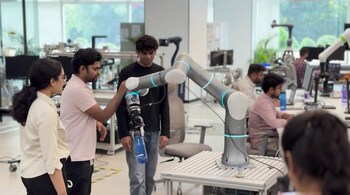


Bengaluru-based deep tech startup CynLr, on February 12, unveiled robots that can learn to pick and manipulate completely unknown objects in 10 to 15 seconds, while flagging that commercial maturity in robotics will require patient capital and a long investment cycle.
CynLr said global manufacturing companies, including auto brands such as General Motors, are evaluating its Object Intelligence platform for real-world factory-floor use. The system is being assessed for tasks such as complex assembly and handling irregular components, areas where traditional industrial automation has struggled.
Founded in 2019, CynLr has raised $15.2 million so far and operates R&D centres in India and Switzerland, with a business development presence in the US. The company was named a Technology Pioneer by the World Economic Forum in 2025.
CynLr said its robots can intuitively handle transparent, reflective, and irregular objects, a long-standing challenge in physical intelligence.
Founder Gokul NA said the robotics industry is still at an early stage, comparable to the computing industry of the 1980s, where it took over a decade for standardisation and meaningful profitability to emerge.
“Most players, including us, are projecting 2028 to 2030 as the period when full-scale revenues can begin,” Gokul said, adding that until then, companies will continue to burn capital to build core infrastructure and market readiness.
He said services-led models can reach break-even faster but limit scalability, while foundational robotics platforms require sustained investment before market expansion becomes viable.
Gokul described robotics as potentially the largest market humanity has seen, as it automates physical effort at scale, but warned that market saturation is still far away.
CynLr is currently raising capital and is looking to secure $40 million plus in its ongoing round, with plans to raise about $75 million by 2028. The funding will be used to build manufacturing and supply chain infrastructure aimed at producing one robot per day, scaling the team beyond 200 employees, and reducing sales cycles to about 40 days.
A significant portion of the capital will go towards customising core components and owning system design, which Gokul said is necessary to overcome supply chain constraints that currently limit performance and customer satisfaction.
Despite growing interest in artificial intelligence, Gokul said robotics and physical intelligence continue to face scepticism from investors due to limited market visibility and long payback periods. He pointed out that while semiconductors continue to attract the largest investments due to proven demand, robotics has yet to demonstrate comparable market acceptance.
“Deep tech needs a different mindset. You are building infrastructure, not packaging an existing market,” he said, adding that India lacks long-term venture funds with deep tech expertise and patience to back such cycles.
Discover the latest Business News, Sensex, and Nifty updates. Obtain Personal Finance insights, tax queries, and expert opinions on Moneycontrol or download the Moneycontrol App to stay updated!





