

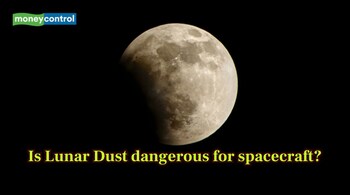
A new study reveals how lunar dust behaves near spacecraft. The research explains why Moon dust stubbornly sticks to machines. It was conducted by Chinese space science researchers recently. The findings matter as nations plan long-term lunar missions.
What Scientists Have Discovered Now?
Researchers from Beijing Institute of Technology and China Academy Space Technology and Chinese Academy of Sciences built a theoretical model to explain lunar dust interactions with spacecraft at low speeds.
This is known as new physical interaction model which explains low-speed collisions between dust and spacecraft. It focuses on electrostatic forces and contact adhesion. These interactions occur when spacecraft operate near the Moon.
How the Lunar Environment Changes Dust Behaviour?
The Moon has no atmosphere to neutralise electric charge. Sunlight charges dust positively on the lunar dayside. Darkness causes negative charging on the lunar nightside.
Spacecraft surfaces also gain electrical charges in these regions. This creates invisible electric fields around lunar vehicles. Dust particles respond strongly to these changing forces.
Why Moon Dust Became a Space Engineering Nightmare?
Lunar dust looks harmless but behaves aggressively in space. It is sharp, electrically charged and highly adhesive. Apollo astronauts first reported dust damaging suits and equipment. Modern missions now face even greater technological risks.
Dust can coat solar panels and clog sensitive instruments. It can degrade thermal systems and shorten mission lifetimes. Understanding dust behaviour has become a scientific priority.
When Dust Hits Spacecraft Surfaces
The model simulates dust striking coated spacecraft panels. It considers common spacecraft materials used on lunar missions. At low speeds, dust rarely bounces away completely. Instead, microscopic forces dominate the collision outcome. Van der Waals forces often outweigh electrostatic repulsion. This causes dust grains to cling tightly to surfaces.
What were these findings that surprised scientists?
Thicker spacecraft coatings reduce electrostatic attraction significantly. Low-permittivity materials weaken dust-surface electric interactions. Surface charge density matters more than overall spacecraft voltage. Particle size, speed and charge determine adhesion likelihood. Very slow dust almost always sticks permanently. Escape becomes impossible below certain energy thresholds.
What Comes Next?
NASA, China and others plan permanent lunar infrastructure. Long-term habitats must survive years of dust exposure. Unchecked dust could cripple landers, rovers, and power systems. Scientists plan to refine the model further.
Future work will include irregular dust shapes. Realistic lunar plasma conditions will also be added. Each improvement brings humanity closer to safer lunar exploration. On the Moon, even dust can decide mission success.
Discover the latest Business News, Sensex, and Nifty updates. Obtain Personal Finance insights, tax queries, and expert opinions on Moneycontrol or download the Moneycontrol App to stay updated!





