

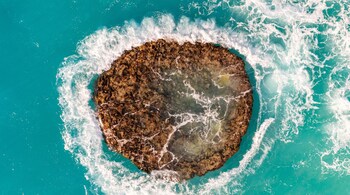
Scientists have uncovered a deep geological mystery beneath Bermuda. New research reveals an unusually thick rock layer below the seafloor. The finding challenges existing ideas about oceanic crust formation.
The discovery involves a 20-kilometre-thick rock layer. This layer sits beneath Bermuda’s oceanic crust. Scientists say such thickness is unprecedented worldwide. The findings were published on 28/11 in Geophysical Research Letters.
Bermuda mystery: What is happening below
Typically, oceanic crust lies directly above Earth’s mantle. Beneath Bermuda, researchers found an extra rock layer. The layer sits within the tectonic plate itself. William Frazer led the study at Carnegie Science. He described the structure as highly unusual.
Bermuda sits atop a raised oceanic swell. Such swells usually form above mantle hotspots. These hotspots drive volcanism and uplift crust. Bermuda’s last eruption occurred 31 million years ago. Despite this, the swell has not subsided.
Scientists say no active volcanism exists today. This absence deepens the geological mystery. Bermuda’s reputation often links to the Bermuda Triangle. Researchers say the real mystery lies underground.
Thick rock layer: What it means
Frazer and co-author Jeffrey Park used seismic data. Park is a professor at Yale University. They analysed earthquake waves passing beneath Bermuda. Changes in wave speed revealed buried structures.
The team mapped depths reaching 50 kilometres below. They identified a less dense rock layer. Scientists believe it formed during ancient volcanism. The material may still support the island’s elevation.
Sarah Mazza from Smith College commented on findings. She was not involved in the study. Mazza said leftover mantle material may remain trapped. Her own research supports a deep mantle origin.
Mazza studied Bermuda’s lava chemistry previously. She found unusually low silica levels. This suggests carbon-rich mantle material. Zinc isotope studies traced carbon deep underground.
That carbon likely dates back to Pangea’s formation. Pangea existed between 900 and 300 million years ago. This history differs from Pacific hotspot islands. Scientists say Atlantic geology remains comparatively young.
Bermuda geology: What comes next
Researchers believe Bermuda may be geologically unique. The Atlantic Ocean formed after Pangea split apart. This younger setting may explain unusual structures.
Frazer is now studying other global islands. He hopes to find similar buried rock layers. This will test whether Bermuda stands alone.
Understanding extreme places helps explain normal Earth processes. Scientists say Bermuda offers a rare geological window. The island may reshape ideas about mantle behaviour.
Discover the latest Business News, Sensex, and Nifty updates. Obtain Personal Finance insights, tax queries, and expert opinions on Moneycontrol or download the Moneycontrol App to stay updated!





