

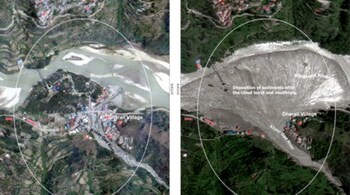
As rescue teams dig through deep mounds of debris, the full scale of Tuesday’s flash flood in Uttarkashi is coming into focus. Villagers, rescue workers and officials are facing blocked roads, missing people and buried homes as operations continue in the battered hills of Uttarakhand. The disaster hit the mountain villages of Dharali and Harsil on 5 August after intense rainfall triggered a destructive surge of water and debris.
At least five people have died and over 100 are still missing after the sudden deluge swept away homes, hotels, bridges and roads. Eleven army personnel from a nearby camp are also unaccounted for, according to PTI. State officials say over 300 pilgrims remain stranded across the district due to washed-out roads. The devastation has left villages cut off and critical infrastructure buried beneath metres of mud.
ISRO’s Satellite Images Reveal Massive Flood Impact
India's space agency ISRO, through its National Remote Sensing Centre (NRSC), used high-resolution Cartosat-2S satellite images to assess the damage. The agency compared post-flood images taken on 7 August with earlier cloud-free data from June 2024. The analysis shows altered river shapes, destroyed buildings and sediment build-up across the affected region.
At Dharali, a fan-shaped deposit of mud and debris covers nearly 20 hectares near the confluence of the Bhagirathi River and Kheer Gad stream. The flood’s force appears to have wiped out several structures completely. Many buildings in the village are now buried or washed away. The satellite findings are being used to guide teams towards possible survivors and blocked areas.
Search Teams Face Hurdles in Isolated Villages
Officials say the blocked mountain roads are delaying urgent help. State Disaster Response Force (SDRF) teams are trying to airlift heavy equipment to aid the search. Rescue workers are using sniffer dogs and may soon deploy ground-penetrating radars. According to SDRF IG Arun Mohan Joshi, mounds of debris are up to 60 feet high in some places, likely hiding people below.
The rescue of pilgrims remains a priority, as many are stranded on routes leading to Gangotri. Dharali is a key stop for pilgrims visiting the Ganga’s origin and has several guesthouses. Uttarakhand Chief Minister Pushkar Singh Dhami is camping in Uttarkashi to supervise relief efforts. Work is expected to speed up once weather improves and roads are cleared.
Experts say the incident highlights how vulnerable Himalayan towns are to sudden floods and climate-linked disasters. Scientific investigations are underway to identify what triggered the intense flash flood and how such events can be better predicted or prevented.
Discover the latest Business News, Sensex, and Nifty updates. Obtain Personal Finance insights, tax queries, and expert opinions on Moneycontrol or download the Moneycontrol App to stay updated!





