

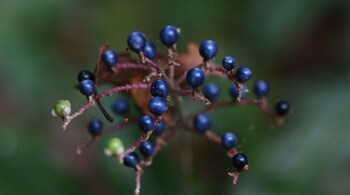


Scientists have revealed how an African fruit produces one of nature’s most intense blue colours without using any pigment, uncovering an optical trick that challenges how colour is understood in the natural world.
Researchers studying the marble berry, Pollia condensata, found the fruit’s striking metallic blue appearance is not created by chemicals, but by microscopic physical structures that manipulate light. The findings, published in the Proceedings of the National Academy of Sciences, highlight one of the most efficient natural reflectors ever measured on land.
How the Marble Berry Creates Colour
The marble berry grows across parts of tropical Africa. Its fruit resembles polished beads and keeps its vivid blue sheen for decades. Scientists from the University of Cambridge examined the berry cells using high-resolution microscopy to uncover the source of this unusual colour. Unlike most plants, the fruit contains no blue pigment. Instead, colour emerges from layers of cellulose fibres arranged in a precise twisting pattern within each outer cell wall.
These fibres force incoming light waves to interact. Some wavelengths cancel each other out, while others reinforce one another. Blue wavelengths survive this process most strongly, giving the fruit its dominant colour. Researchers reported that around 30% of incoming light is reflected, an unusually high figure for any biological surface found on land.
Why This Blue Is Different
The study found the fruit’s reflectivity exceeds that of beetle shells, bird feathers, and even Morpho butterfly wings. Small variations in the thickness of fibre layers cause slight colour shifts across the fruit surface. As a result, tiny patches of green and red appear among the dominant blue, producing a subtle pixelated appearance unlike anything previously recorded.
Scientists note that structural colour is common in animals, but extremely rare in fruits. A similar, though weaker, effect exists in Elaeocarpus angustifolius fruits, yet none match Pollia condensata’s intensity or durability. Because this colour is structural, it does not fade with age, sunlight, or decay.
What This Means for Survival
The berry offers no nutritional reward. Birds carry the fruit only because its appearance is irresistible. The researchers believe this visual signal evolved to ensure seeds spread widely without the plant investing energy into food production. According to Cambridge plant scientist Beverley Glover, the plant attracts attention while conserving valuable photosynthetic resources.
The discovery could inspire new colour technologies that avoid pigments altogether. Scientists say nature still outperforms human engineering when it comes to efficient, long-lasting colour. The marble berry stands as a reminder that some of the most advanced optical designs already exist quietly in the wild.
Discover the latest Business News, Sensex, and Nifty updates. Obtain Personal Finance insights, tax queries, and expert opinions on Moneycontrol or download the Moneycontrol App to stay updated!





