

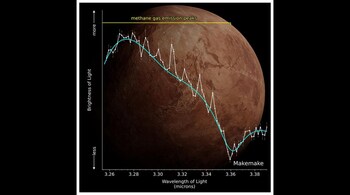
A far-off dwarf planet, Makemake, now has a new secret. Scientists detected methane gas above its frozen surface. The discovery reveals Makemake is more dynamic than believed.
How Was Methane Gas Detected on Makemake?
A research team led by Southwest Research Institute used NASA’s James Webb Space Telescope (JWST). They reported the first-ever detection of gas on Makemake. Previously, only Pluto among trans-Neptunian objects had confirmed gas. The team published their findings in The Astrophysical Journal Letters. Dr Silvia Protopapa, lead author, said Makemake’s surface is covered in frozen methane. The Webb telescope revealed methane in the gas phase too. This shows the planet is not a static remnant. Rather, it is still active, with methane ice continuing to evolve.
The methane emission is explained by solar-excited fluorescence. Sunlight interacts with methane molecules, causing them to emit light. The researchers suggest two possible scenarios. Either Makemake has a thin atmosphere in balance with surface ice. Or there is transient activity, like cometary sublimation or cryovolcanic plumes. Current data cannot clearly favour one explanation. Noise levels and limited spectral resolution limit conclusions.
Why Is This Discovery Important for Solar System Science?
Makemake spans about 1,430 kilometres, two-thirds of Pluto’s size. Scientists had long studied its mysterious thermal anomalies. Prior data hinted at localised hot spots on its surface. Stellar occultations suggested a lack of a global atmosphere. However, a thin atmosphere remained a possibility. Dr Ian Wong, co-author, highlighted the need for further research. Future Webb observations at higher spectral resolution are planned. These will help clarify methane’s origin.
Dr Emmanuel Lellouch from the Paris Observatory explained the discovery’s implication. Methane could form a tenuous atmosphere through sublimation. Models suggest a temperature near 40 Kelvin, about -233 degrees Celsius. Surface pressure is estimated at roughly 10 picobars. This is 100 billion times thinner than Earth’s atmosphere. It is a million times more tenuous than Pluto’s atmosphere.
Protopapa added another view: methane may release in plume-like outbursts. Models estimate release rates at several hundred kilograms per second. This is similar to Enceladus’ water plumes but far greater than Ceres’ vapour.
The research highlights the connection between Webb observations and spectral modelling. It offers fresh insights into volatile surfaces in the trans-Neptunian region.
The paper, “JWST Detection of Hydrocarbon Ices and Methane Gas on Makemake”, is available on arXiv. It will soon be published in The Astrophysical Journal Letters.
Discover the latest Business News, Sensex, and Nifty updates. Obtain Personal Finance insights, tax queries, and expert opinions on Moneycontrol or download the Moneycontrol App to stay updated!






