

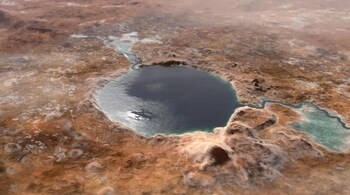
A new study has revealed compelling signs that Mars may have once supported microbial life, according to research led by NASA and supported by Imperial College London. Scientists analysing samples from the Jezero Crater have identified minerals and organic matter within Martian rocks that hint at a habitable environment and possible biological activity in the planet’s distant past.
The discoveries were made in a light-toned geological layer known as the Bright Angel formation, where sedimentary structures linked to organic carbon could represent potential biosignatures. Professor Sanjeev Gupta from Imperial College said the findings were significant but cautioned that more work is needed. He added that only by analysing these rock samples on Earth can scientists confirm whether biological processes were truly involved.
What Did Perseverance Uncover in Jezero Crater?
Since 2021, NASA's Perseverance rover has been exploring Jezero Crater, selected because it had a lake and river delta in the past. Its purpose is to gather rock and soil samples that could contain evidence of ancient life. In investigating Neretva Vallis, Perseverance found fine-grained mudstones and conglomerates with silica and clays, which indicate a quiet, low-energy lake environment as opposed to a river system.
This unexpected find suggests that some of the valley was at one time underwater, creating a lake that supported life. Additional study showed iron-phosphate and iron-sulphide minerals within the rocks that were created by redox reactions using organic carbon. These reactions would be caused by either normal chemical processes or microorganisms, and they would present a possible biosignature like those on Earth.
What Happens Next for Mars Samples?
To verify if these chemical signals are biological, researchers have to analyze the samples in Earth-based labs. Thankfully, Perseverance has already drilled and saved a core sample of Bright Angel, called "Sapphire Canyon." These and other samples are waiting for the Mars Sample Return mission, a NASA-ESA collaboration scheduled in the 2030s.
Once they're on Earth, sophisticated equipment will enable scientists to identify the mineral sources and whether the minerals point to ancient microbial life. Scientists feel the results are some of the best evidence to date that Mars had once been home to habitable environments.
Matthew Cook of the UK Space Agency added that the findings represent a significant step towards unlocking Mars and the possibility of life beyond our planet. He said future missions, such as the UK-designed Rosalind Franklin rover, will be crucial to solving one of humanity's biggest questions: are we alone?
Discover the latest Business News, Sensex, and Nifty updates. Obtain Personal Finance insights, tax queries, and expert opinions on Moneycontrol or download the Moneycontrol App to stay updated!





