

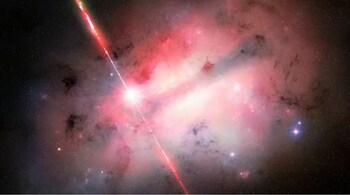
Astronomers are studying an unusually long gamma-ray burst detected on July 2. NASA’s Fermi Gamma-ray Space Telescope observed sustained emissions exceeding seven hours.
What happened during GRB 250702B observation
Gamma-ray bursts are usually detected once every day. This event, named GRB 250702B, behaved very differently. It became the longest-duration gamma-ray burst ever recorded. Scientists think it came from a rare explosion type. The explosion launched a narrow jet towards our solar system. That jet travelled at least 99% light speed.
Astronomers worldwide moved quickly to trace its afterglow. They observed the event across all light wavelengths. Telescopes included Gemini in Chile and Hawaii. The Very Large Telescope in Chile participated. Hawaii’s Keck Observatory and Hubble also contributed.
Why distance and dust mattered
Gamma-ray bursts come from extreme cosmic distances. NASA says even the nearest formed over 100 million light-years away. GRB 250702B originated from a massive distant galaxy. The galaxy lies roughly 8 billion light-years away. Heavy dust blocked nearly all visible light emission.
Only infrared and high-energy X-ray light was detected. Thick dust made the burst nearly invisible optically. Researchers reported this in Astrophysical Journal Letters. The study was published on Nov. 26.
What the discovery means for science
Lead author Jonathan Carney highlighted the burst’s uniqueness. He is a doctoral student at North Carolina Chapel Hill. Carney said existing models cannot explain such behaviour. Scientists are now reassessing how gamma-ray bursts form.
Discover the latest Business News, Sensex, and Nifty updates. Obtain Personal Finance insights, tax queries, and expert opinions on Moneycontrol or download the Moneycontrol App to stay updated!






