

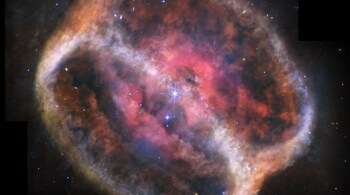
It’s not often we witness beauty in decay. But NASA’s James Webb Telescope has captured one such moment. A dying star’s farewell, aglow in dust and gas, is now seen with striking clarity.
Nebula seen clearer with Webb’s infrared eyes
The image focuses on NGC 1514, a planetary nebula. This stunning sight lies about 1,500 light-years from Earth. Gas and dust ejected by a dying star now appear in new detail. Thanks to Webb’s mid-infrared lens, the rings look “fuzzy” yet defined. They are tangled in patterns and scattered with clearer holes.
These holes show where fast winds broke through. Before Webb, most of this could not be seen. “With MIRI’s data, we now study the turbulence,” said Mike Ressler, project scientist at NASA’s Jet Propulsion Laboratory. He first spotted the rings in 2010 using WISE data.
A 4,000-year-old scene still evolving
This celestial scene began forming over 4,000 years ago. It continues to shift with time and movement. At its centre are two stars, appearing as one. They follow a tight, nine-year orbit around each other. One star, once massive, led this dramatic exit.
“As it aged, it puffed off layers slowly,” said David Jones, an astrophysicist in the Canary Islands. “That material formed the dust we now see.” Once the outer layers drifted away, only a hot core remained. As a white dwarf, it pushed faster winds outward. These may have swept material into thin, glowing shells.
Hourglass shape hides more than it shows
Webb’s images suggest a tilted, hourglass structure. Dust forms orange arcs, resembling shallow ‘V’ shapes at each end. This could be the result of interaction between stars. “The companion may have come too close,” said Jones. “That may have shaped the rings oddly, not like a sphere.”
More details appear in the space between rings. Semi-transparent orange clouds give depth to the nebula’s form. Webb’s data also show faint oxygen in the clumpy pink centre. It sits near the bubbles and hollow parts in the dust.
Dust, oxygen, and missing molecules
The uneven rings glow warmer in some areas. This is due to very fine dust grains heating up. “Ultraviolet light heats the grains just enough,” Ressler explained. That warmth lets Webb detect them clearly in mid-infrared.
Oddly, the nebula lacks carbon-based molecules. Most nebulae have smoke-like hydrocarbons. But here, they weren’t found. Scientists think the stars’ orbit may explain it. Their movement stirred up dust, halting molecule formation. The clearer composition helps starlight travel much farther. That’s why the faint, cloudy rings are still visible.
A bright blue star appears in the lower left. But it does not belong to this nebula. It is closer to us and shines separately.
Centuries of observation, now with clarity
NGC 1514 has been known since the 18th century. Astronomer William Herschel studied it in 1790. It was the first deep-sky object he found too cloudy to resolve. He could not see stars within, unlike other clusters.
Today, Webb offers a much sharper view. With each image, we see death in space as a slow, radiant show — one still unfolding above us.
Discover the latest Business News, Sensex, and Nifty updates. Obtain Personal Finance insights, tax queries, and expert opinions on Moneycontrol or download the Moneycontrol App to stay updated!





