

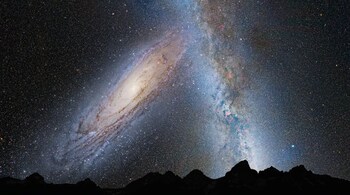
In the immense expanse of space, where galaxies spin and twirl like dancers, our Milky Way is accompanied by its cosmic neighbour, Andromeda. This galaxy is racing towards us at an incredible speed of 250,000 miles per hour. For many years, scientists have warned that a collision between the Milky Way and Andromeda was a sure thing, one that could dramatically alter our cosmic surroundings. But a new study has thrown a curveball, suggesting there’s actually a 50 per cent chance that this collision might not happen after all.
New Insights from "Apocalypse When?"
A recent study with title "Apocalypse When?" questions the long-standing belief that our Milky Way is definitely heading for a collision with Andromeda. Using data from the Gaia and Hubble telescopes, a team of scientists led by Till Sawala from the University of Helsinki has explored the universe's secrets. They looked at not just the Milky Way and Andromeda but also other big galaxies nearby, like Triangulum and the Large Magellanic Cloud.
Rethinking the Galactic Collision
The findings are surprising: the much-feared collision might not be a certainty after all. In nearly half of the scenarios they studied, the Milky Way and Andromeda do not collide. Instead, they might just continue their cosmic waltz without ever coming to blows. "Proclamations of the impending demise of our Galaxy appear greatly exaggerated," the researchers noted, offering a glimmer of hope amidst the cosmic uncertainty.
Implications for Our Solar System
If a collision were to occur, it would have profound implications for the future of our solar system. The merging of the Milky Way and Andromeda would eventually create a single, elliptical galaxy, forever altering the structure of the cosmos. Our solar system, currently nestled comfortably in the Milky Way's spiral arms, could be flung into an entirely new region, far from the galactic core we call home.
The Future is Uncertain
While previous studies have painted this cosmic collision as an inevitability, this new research injects a note of caution, reminding us that the universe is full of surprises. The paper, which is currently undergoing peer review, has sparked renewed interest in the fate of our galaxy and the forces that govern the universe.
As we look up at the night sky and think about the future of the Milky Way, it's comforting to know that nothing is set in stone. The universe is full of surprises, and even the most certain predictions can change. Whether our galaxy will end up colliding with Andromeda or just keep on its path, only time will tell. In the meantime, we can appreciate the incredible beauty and mystery of space, knowing we’re part of something much bigger than ourselves.
Discover the latest Business News, Sensex, and Nifty updates. Obtain Personal Finance insights, tax queries, and expert opinions on Moneycontrol or download the Moneycontrol App to stay updated!





