

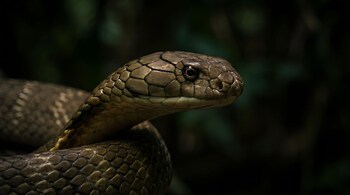
Researchers and conservation workers in southern India are intensifying efforts to manage human snake encounters. Field teams from the Agumbe Rainforest Research Station are responding daily to emergencies. The work highlights rising human wildlife contact across the Western Ghats.
What is happening in the Western Ghats
On a warm November morning, a rescue call interrupts forest quiet. A king cobra is reported near a rural school. Ajay Giri leads the response from Agumbe Rainforest Research Station. The station operates within dense forests of Karnataka. It was founded by herpetologist Romulus Whitaker decades ago.
ARRS is affiliated with the Madras Crocodile Bank Trust. The centre has become a leading authority on king cobras. Researchers here pioneered radio telemetry for studying wild king cobras. Alongside research, teams regularly rescue snakes entering settlements. These efforts support conservation and reduce community conflict risks.
At a nearby house, the cobra hides within wooden roof beams. Children watch silently as the rescue begins. Using a metal hook, Giri carefully lifts the snake. He avoids sudden movements to reduce stress. The cobra briefly flares its hood defensively. Moments later, it slides safely into a capture bag.
Why king cobra rescues matter
King cobras are India’s longest venomous snakes. Adults often reach lengths of 3 to 3.5 metres. They belong to the elapid family with fixed fangs. Despite their size, they rarely bite humans. However, rescues demand extreme caution and experience.
Giri has handled king cobras for over 17 years. He has rescued hundreds without a single bite. He also works with India’s dangerous big four snakes. These include Russell’s vipers, kraits, saw scaled vipers, and cobras. Unlike these species, king cobras show calmer behaviour.
Snakes enter villages searching for prey like rodents. Rural homes often attract them unintentionally. Snakebites kill 40,000 to 60,000 people annually in India. For every death, several victims suffer permanent injury. Karnataka now treats snakebite as a notifiable disease.
There is no specific antivenom for king cobras. Existing antivenoms target only the big four species. Venom also varies between regions, reducing treatment effectiveness. Many rural victims delay hospital care, worsening outcomes.
What comes next for coexistence efforts
ARRS teams prioritise releasing snakes close to capture sites. This prevents relocation stress and repeat encounters. Some cobras carry PIT tags for identification. Others are fitted with radio transmitters beneath their skin. Tracking reveals movement patterns and habitat use.
During breeding season, rescues increase sharply. Males roam widely seeking mates before monsoon rains. King cobras uniquely build nests for their eggs. Females guard nests until hatching, sometimes near human areas.
Education now forms a core ARRS mission. Teams conduct school sessions and village outreach programmes. They distribute flyers and explain safe practices. Simple steps reduce risk, including footwear and torch use.
As night falls, another rescue call arrives urgently. A large cobra appears after biting a dog. The snake is captured, weighed at 8 kilograms, and scanned. It is a known individual previously rescued.
The cobra is released quietly into forest undergrowth. It disappears into darkness, vital to the ecosystem. As urban expansion continues, such encounters may increase. Conservation groups say coexistence remains the only sustainable path.
(Inputs From BBC)
Discover the latest Business News, Sensex, and Nifty updates. Obtain Personal Finance insights, tax queries, and expert opinions on Moneycontrol or download the Moneycontrol App to stay updated!





