

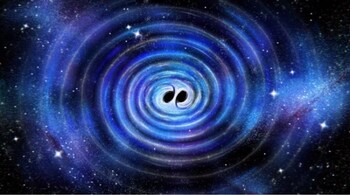
The universe still holds its secrets, which it yields unexpectedly. Recently, scientists first measured the recoil velocity of a black hole. This is an astonishing breakthrough that informs us about the spectacular consequences of black hole mergers.
What Happened During the Black Hole Collision?
Gravitational waves are space-time ripples predicted by Einstein. They were observed for the first time in 2015, and they have opened up a new frontier of astronomy. Another major event occurred in 2019 when researchers observed a signal named GW190412. The signal originated from a cataclysmic merger of two black holes. The two black holes were of highly unequal masses, producing an unusual outcome.
The size imbalance caused the newly formed black hole to get a powerful push. Researchers call this phenomenon a “natal kick”. This kick sent the black hole shooting through space at more than 31 miles per second, or 50 kilometres per second. The speed was enough to eject it from its star cluster, scientists reported. The study was published in Nature Astronomy on 9 September.
How Do Scientists Measure the Kick's Speed and Direction?
When black holes collide, they release gravitational waves. The waves contain information on the collision. If one black hole is much heavier, the waves vary with the observation angle. Scientists analysed GW190412 from two Earth-based angles. This helped them determine the kick’s direction and speed. The mass ratio and spin of the original black holes were key data points. Such data are crucial to track the formation of supermassive black holes. These giants can reach up to 50 billion times the sun’s mass. A strong recoil prevents the new black hole from merging again. This affects the overall growth of cosmic black holes.
Read Also: Stephen Hawking’s and Einstein’s theories confirmed as scientists ‘hear’ two black holes merging
How Was This Discovery Made Possible?
In 2018, researchers developed a method to measure the natal kick. At first, they relied on computer simulations. No actual recoil event had been recorded yet. Then on 12 April 2019, Advanced LIGO in Louisiana and Washington State, along with Virgo in Italy, detected the signal. The black holes were 29.7 and 8.4 times the sun’s mass. The event occurred more than 2.4 billion light-years away. The merged black hole likely came from a dense globular cluster. It sped away at 111,600 miles per hour, or 179,600 kilometres per hour. The speed was enough to escape the cluster entirely.
What’s Next for Black Hole Research?
“This is one of the few phenomena we can fully reconstruct,” said Koustav Chandra, an astrophysicist at Pennsylvania State University. Scientists now aim to observe more black hole mergers. Future scientists will merge gravitational waves with visible light information. This will potentially show how black holes evolve into cosmic giants. The researchers hope these endeavours will lead to further insight. Each discovery helps us understand the universe’s most powerful objects.
Discover the latest Business News, Sensex, and Nifty updates. Obtain Personal Finance insights, tax queries, and expert opinions on Moneycontrol or download the Moneycontrol App to stay updated!





