

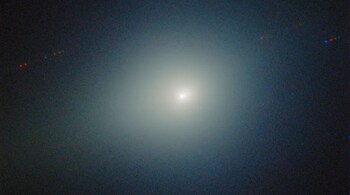
New telescope images reveal interstellar comet 3I/ATLAS intensifying rapidly. The images show the object growing brighter and greener recently. Scientists say the change follows its close solar passage. The observations focus on activity ahead of Earth’s upcoming flyby.
The images were taken on 26/11/2025 using Gemini North. The telescope is located atop Hawaii’s dormant Mauna Kea volcano. Researchers observed the comet during one of its active phases. Heating from intense sunlight is driving major surface changes. Ice is sublimating and releasing dust into surrounding space. This process forms a glowing coma and extended tail.
3I/ATLAS comet: What is happening now
To capture the images, astronomers used four observation filters. These included blue, red, orange, and green wavelengths. The comet’s coma now emits a faint green glow. This colour was absent during observations several months earlier. According to NOIRLab, diatomic carbon causes the green light. The molecule emits green when excited by sunlight. NOIRLab operates the Gemini telescopes in Hawaii and Chile.
Many solar system comets show similar green colouring. Examples include comet 12P Pons-Brooks and C/2025 F2. However, earlier images showed 3I/ATLAS appearing distinctly redder. Gemini South captured those observations during late August. Scientists say this suggests new molecules are emerging. The colour change offers clues to internal composition.
3I/ATLAS comet: What it means for science
Researchers believe heating is exposing fresh subsurface material. This process may reveal information about the comet’s makeup. The comet approaches Earth on 19/12/2025. It will pass within 170 million miles of Earth. That distance equals roughly 270 million kilometres. Scientists say further activity remains uncertain.
NOIRLab notes comets often react slowly to solar heating. Heat can take time reaching interior layers. This delay may activate new chemical evaporation. It can also trigger sudden comet outbursts. Scientists will closely monitor changes during departure.
3I/ATLAS comet: What comes next
3I/ATLAS is the third interstellar object discovered. It follows 1I Oumuamua and 2I Borisov. The comet was detected in late June. It travelled through the solar system at extreme speed. Estimates place its velocity near 130,000 miles per hour. Its hyperbolic orbit means it will never return.
Scientists believe it is the largest interstellar visitor. It is likely also the oldest discovered so far. Observations show large sun-facing jets and radiation exposure. Experts dismiss claims suggesting artificial or alien origins. Astronomers agree it behaves like a natural comet.
Dozens of observatories continue tracking the object closely. They aim to measure its size, trajectory, and composition. Researchers hope to learn about early star systems. Studying 3I/ATLAS may reveal galactic formation secrets.
Discover the latest Business News, Sensex, and Nifty updates. Obtain Personal Finance insights, tax queries, and expert opinions on Moneycontrol or download the Moneycontrol App to stay updated!





