

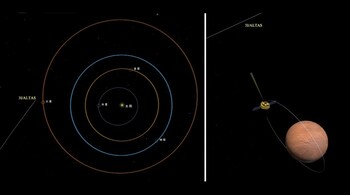
China's Tianwen-1 orbiter has done what few could fathom: it has photographed an interstellar object millions of kilometres away, giving a rare glimpse into the far reaches of space. Using its high-resolution camera, the spacecraft captured the faint image of 3I/ATLAS, a mysterious celestial body speeding through our solar system.
What did Tianwen-1 observe?
According to the China National Space Administration (CNSA), Tianwen-1 successfully observed 3I/ATLAS from a distance of about 30 million kilometres. The orbiter’s camera recorded clear images showing the object’s nucleus and its hazy coma, features that give it a comet-like appearance. Scientists later produced an animated sequence using 30 seconds of images to study the object’s motion path.
Why is this observation important?
This marks one of the closest studies of 3I/ATLAS ever achieved by a probe. The object was discovered on 1 July 2025 by a sky survey telescope in Chile. Researchers believe it originated near ancient stars close to the galactic centre, making it between 3 and 11 billion years old — possibly older than the solar system itself. This gives scientists a valuable opportunity to study the composition and evolution of exoplanets and the early history of stars.
How difficult was the task?
The observation was highly demanding. The object lies 30 million kilometres away, moves at 58 kilometres per second, and has a relative speed of 86 kilometres per second compared to Tianwen-1. Adding to the challenge, 3I/ATLAS is only 5.6 kilometres wide and is 10,000 to 100,000 times dimmer than the Martian surface.
How did the team prepare for the mission?
The Tianwen-1 team began preparations in early September. Engineers carried out multiple simulations and theoretical models to locate and photograph the object with precision.
The optical payload was designed to image Mars and had never been used against such a faint and distant target. Notwithstanding, the team carried out the task successfully through careful planning and coordination.
What does this mean for future missions?
The success of this observation has given the CNSA team valuable experience for the upcoming Tianwen-2 asteroid exploration mission. It also proves that the Tianwen-1 orbiter, which entered Mars’ orbit in February 2021, continues to operate stably after four years and eight months in space.
Tianwen-1’s achievement not only adds to China’s growing space record but also opens a new window into understanding the origins of interstellar objects—the ancient travellers that carry secrets from beyond our solar system.
Discover the latest Business News, Sensex, and Nifty updates. Obtain Personal Finance insights, tax queries, and expert opinions on Moneycontrol or download the Moneycontrol App to stay updated!





