

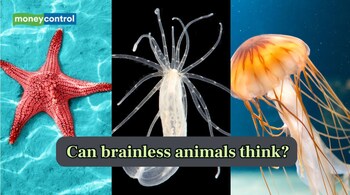
Some animals lack brains yet perform astonishingly complex actions. Animals such as Jellyfish, sea urchins and starfish do not have brains, but does that mean they do not think. They have some strategies of their own to survive in wildlife. These creatures challenge our ideas of what it means to think.
Who did this research?
The research was conducted by a team of biologists from University of Fribourg in Switzerland and Universitat de Barcelona in Spain. They used the species Starlet Sea Anemone (Nematostella vectensis) in a lab to test associative learning.
Experiments involve repeated stimuli to test adaptive responses reliably. These simple animals demonstrate learning that rival's expectations of complexity.
Animals who can "think" without brain
The Starlet Sea Anemone can learn associations between stimuli. It links light flashes with mild electrical shocks. There is box jellyfish who navigate obstacles using visual cues rather than reflexes. Sea stars adjust their movements, showing awareness of space around.
These brainless beings rely on vast nerve nets instead of neurons. Their bodies act as decentralised brains, sensing, remembering and responding. This is a proof that intelligence can thrive even without a head.
Why Scientists Are Amazed?
Brains were long assumed essential for intelligence and memory. The findings about these animals show distributed nerve networks can process complex information. Cognition may arise from networks, not centralised brain structures alone. Studying these animals offers a new perspective on evolution of thought.
What This Means for Science?
Intelligence may not be a brain-bound phenomenon after all. Brainless cognition forces a rethink of animal behaviour and consciousness. Even the simplest life forms can solve problems creatively. This reshapes how to understand evolution, learning and survival strategies.
Discover the latest Business News, Sensex, and Nifty updates. Obtain Personal Finance insights, tax queries, and expert opinions on Moneycontrol or download the Moneycontrol App to stay updated!





