

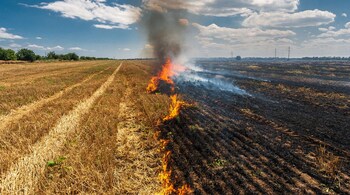
Seasonal crop fires across northern India are increasingly ignited later daily, satellite scientists warn, complicating monitoring and air quality assessments during the October to December stubble-burning season, NASA said on 2025-12-16.
For decades, smoke corridors have stretched across the Indo-Gangetic Plain each autumn. Farmers traditionally burned rice residue soon after harvest completion. In 2025, the season’s overall spread appeared broadly familiar. Yet scientists observed a clear shift in daily fire timing.
Changing fire timings across northern India
Air quality worsened in Delhi and several cities after late October. Hiren Jethva, a Morgan State University scientist at NASA Goddard, tracked conditions. He said pollution persisted for roughly 1 month. For nearly 10 years, he has analysed satellite fire patterns. Earlier seasons showed fires peaking between 1 p.m. and 2 p.m.
Recent years reveal a steady move towards evening burning. Jethva found most fires now ignite between 4 p.m. and 6 p.m. He said farmer practices appear to have changed. The trend emerged using GEO-KOMPSAT-2A satellite observations. The South Korean satellite records data every 10 minutes.
Other monitoring systems face important detection limits. Sensors like MODIS or VIIRS pass overhead once or twice daily. They can miss fires ignited later during evenings. Scientists say this reduces accurate fire counting.
Satellite evidence and pollution impacts
Imagery highlights the scale of smoke impacts, researchers said. On 2025-11-11, NASA’s Aqua satellite observed thick haze. Smoke spread across Punjab, Haryana, Uttar Pradesh, and Madhya Pradesh. News reports said air quality index levels crossed 400. This marked the strongest pollution category nationally.
Authorities responded with temporary school closures in some areas. Construction activity faced tighter restrictions during severe episodes. Weak winds and stagnant air worsened pollution retention. Concentrations exceeded World Health Organization limits several times.
Jethva’s analysis showed moderate burning across Punjab and Haryana. Fire counts exceeded levels seen during 2024, 2020, and 2019. However, they remained lower than during 2023, 2022, and 2021.
What studies say about causes and risks
Indian researchers have reported similar timing changes independently. A Current Science study published in 2025 examined Meteosat Second Generation data. It found peak activity shifting from 1:30 p.m. in 2020. By 2024, peaks moved closer to 5:00 p.m.
In 2025-12, the International Forum for Environment, Sustainability & Technology released findings. Their multi-satellite analysis reached comparable conclusions. Scientists say later fires may alter pollution build-up dynamics.
The contribution of stubble burning remains widely debated. Sources include vehicles, industries, domestic fuels, fireworks, and dust storms. Pawan Gupta, a NASA air quality researcher, cited varied estimates. Studies suggest contributions range between 10% and 50%.
Gupta said crop fires may account for 40% to 70% daily. Monthly averages fall near 20 to 30 per cent. Annual averages drop below 10%. He noted meteorology adds further complexity. Shallow boundary layers and low temperatures intensify impacts.
Scientists warn evening fires could worsen overnight pollution accumulation. Later burns coincide with calmer winds and lower boundary layers. These conditions allow pollutants to linger longer. Researchers say improved monitoring strategies may be needed ahead.
Discover the latest Business News, Sensex, and Nifty updates. Obtain Personal Finance insights, tax queries, and expert opinions on Moneycontrol or download the Moneycontrol App to stay updated!





