

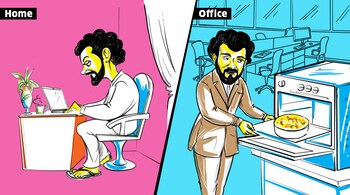
With work from home (WFH) likely to continue in some hybridized form even after the pandemic has receded, shouldn't we start provisioning for rest in office (RIO) as well. And that’s not just about throwing in a few table tennis tables, a half-baked gym, a coffee churning machine and a few awkward sofas scattered across the hallways. No, this is the rest we really enjoy at home - elaborate meals, hours of binge watching utterly inane shows and equally meaningless cricket games and of course long afternoon siestas after gorging on mangoes and watermelons.
While anyone who runs an office is sure to baulk at the very thought of the sacred space being put to such blasphemous uses, we do need to look at restoring the work-life balance which has clearly gone askew this past year.
There’s a reason why the workplace and the home were physically kept apart, notwithstanding calls from time to time to dissolve the difference between the two. The act of picking up one’s bag in the evening, whatever the time, and leaving for home, sends a clear signal to the brain that it is time to relax from work-related stresses. While in recent decades, the pernicious practice of carrying your work (and workplace) home came to be the accepted norm, some of the most productive people have always resisted it. Top banker Aditya Puri, for instance, in his time at HDFC Bank, always left office by 5.30 pm, didn’t wear a watch or carry a mobile phone and didn’t use email. His at-home life was distinct and different from life at work. Deepak Shourie, a media industry veteran who built such brands as Outlook and Discovery in India, is another top executive who has always believed in a clear work-life separation.
Unfortunately, WFH has blurred that distinction to a point where most executives say they don’t know when the workday starts and when it ends. This has had disastrous consequences, with surveys indicating a significant decline in mental health, job satisfaction and motivation levels among employees.
Companies did initially see great benefits from WFH in the form of increased employee productivity and reduced overhead costs. However, with the format losing its novelty, productivity has been plateauing. The biggest casualty is the decline in creativity and innovation which need the relationships and the bonding that physical meetings foster. Microsoft, whose video-calling app Skype has been one of the most-used tools for virtual meetings, recently commissioned a research project with Boston Consulting Group and KRC Research. One of the findings of the report was that “while maintaining productivity hasn’t been an issue with remote working – a strain on team culture seems to be hampering innovation.” As Dr Michael Parke of The Wharton School of the University of Pennsylvania and a research collaborator commented: “It seems that employees are able to hunker down and get less distracted while working remotely, and they can even enjoy less or no commute times, dressing casually (less time to get ready for work), and take better care of home chores. However, the cost seems to be a loss of sense of purpose, which at work, is largely driven through strong and cohesive relationships and seeing how your tasks have impact on others. Both of these are more easily accomplished when people work co-located and are more challenging when working virtually.”
In fact, the time saved in commuting is increasingly being offset by a sharp increase in phone calls, video meetings and formal messaging. Add to that the tension of logging into the corporate network at the given time and staying online not knowing when you will be called in for a task. At senior levels, there are always ways of circumventing these exacting clauses. But younger employees unused to remote working and often living on their own, are missing out on the informal collaboration and the friendly advice from a senior pro that kept them going in difficult times at work. That’s a painful reality of remote working that productivity assessments have failed to measure.
WFH is here to stay, at least in some blended form. Global Workplace Analytics’ analysis of 2018 American Community Service (ACS) data, indicates that 25-30% of the workforce will be working at home on a multiple-days-a-week basis by the end of 2021.
Against that reality, it is critical for companies to devise ways to separate the two environments, work and home. Otherwise, prepare for a world where pajama-clad execs will be belting out songs in the corridors of the office even as Blueberry muffins bake in the canteen microwave.
Discover the latest Business News, Sensex, and Nifty updates. Obtain Personal Finance insights, tax queries, and expert opinions on Moneycontrol or download the Moneycontrol App to stay updated!





