

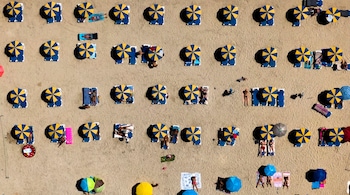
When Lamin Ngobeh, a high school teacher at the Freire Charter School in Wilmington, Delaware, saw a social media post last month about working remotely in Barbados for 12 months, his interest was piqued.
“My school probably won’t open for in-person classes at least until February 2021, and I want to be in a country that’s safer — health wise — and also enjoy the quality of life,” he said of the reasons for considering a temporary relocation. “I reached out to my school leaders and they were very supportive of my decision.”
When it announced its 12-month Welcome Stamp program in mid-July, Barbados became one of the first of several countries, in regions from the Caribbean to Eastern Europe, to create programs for remote workers. The programs employ either special visas or expand existing ones to entice workers to temporarily relocate. Other countries offering similar visas currently include Estonia, Georgia and Bermuda.
A substantial drop in these countries’ tourism numbers is a key reason for the new programs.
“Tourism is the lifeline of the country,” said Eusi Skeete, the U.S. director of tourism for Barbados. Tourism accounted for 14% of the country’s annual gross domestic product in 2019, according to data published by the Central Bank of Barbados, and had a record number of international arrivals of more than 712,000. But in 2020, the number of visitors during the months of April, May and June were near zero.
Skeete said that the country’s new remote worker visa program will help with those numbers.
“A 12-month period will allow visitors to experience the country in a holistic way,” he said.
More than 1,000 applications from around the world were submitted within the first week, the country said, with the majority of responses from the United States, Canada and Britain.
Ngobeh’s application was approved Monday. He plans to move mid-September.
Catering to the Digital Nomad
Even before the pandemic, the number of remote workers worldwide was growing: Research from the consulting firm MBO Partners found that the number of independent workers in the United States, which includes consultants, freelancers and temporary workers, was around 41 million in 2019. More than 7.3 million workers in the U.S. described themselves in 2019 as “digital nomads”: those who chose to embrace a location-independent lifestyle that allowed them to travel and work remotely.
David Cassar, MBO Partners’ chief operations officer, notes that the international leverage of freelancers is increasing considerably.
“We absolutely expect interest in becoming a digital nomad to spike among independent workers in the coming years. COVID-19 has accelerated the adoption of widespread remote work, and independent workers will be among the first to take advantage of a location-independent, technology-enabled lifestyle,” he said.
Many workers are drawn to the lifestyle of digital nomads because of a lower cost of living.
Maggie Turansky, whose hometown is Phoenix, currently lives in the Republic of Georgia. She runs a website, The World Was Here First, with her partner, and rents a brand-new apartment in Tbilisi for about $500 a month. They stayed there during the pandemic.
“I can’t think of any other major city in a Western country that would be comparable,” she said. “The utilities on top of that rarely go above $50 a month, and the Wi-Fi is great. Georgia is appealing and there’s so much to see and do, and we kind of fell in love with it.”
Ngobeh noted that he has found decent two- to four-bedroom apartments that rent from $500 to $1,500 a month.
Amanda Kolbye, another U.S. citizen, currently works from Malaysia as an online business coach. She has enjoyed living and working overseas for the past two years, living in six countries, including Thailand, Vietnam, Indonesia, Qatar and Taiwan.
“I’m not planning to return to the U.S. for the foreseeable future,” Kolbye said. “I’m considering running my business in another country, like Estonia or Barbados or Bermuda that will allow me to be closer to home.”
Criteria for Extended Stays
Some criteria for international visitors who seek these extended stays are similar.
While all countries require proof of health insurance and negative virus tests (either pre-arrival, upon arrival, or both), some require an application fee and proof of a monthly salary, complete with bank statements.
For Barbados, prospective remote workers need to fill out an online application form and submit photos. They also need to supply proof of employment and an income declaration of at least $50,000 annually during the period that they are on the island. An application fee of $2,000 per person is only payable after he or she is approved; families pay a fee of $3,000, irrespective of the number of members in their household.
Bermuda’s Residency Certificate Policy, which was announced Aug. 1, has an application fee of $263.
Edward David Burt, the premier of Bermuda, said that the certificate did not require any change in law (the country has issued residential certificates before), but rather an expansion of it.
“This will certainly help with our tourism industry,” he said. “You can have either 52 weeklong tours, or one 52-weeklong tour — the bottom line is the same: that it will support our economy.”
In 2019, Bermuda reported $419 million in leisure tourism revenue and more than 808,000 visitors — the most in the country’s history. Not surprisingly, the pandemic has depressed these numbers. In the first quarter of 2020, Bermuda’s tourism spending was $19.8 million compared to $32 million the previous year, and leisure air arrivals fell by nearly 44%.
“Tourists during the months of April, May and June were nearly zero,” said Glenn Jones, the interim chief executive officer of the Bermuda Tourism Authority. “I can tell you that we live on air arrivals. In July, our airlift capacity — the number of commercial airline seats flying to the island — was just 10% of what it was last July. August will be just 20%.”
Within days of announcing its residential certificate program, Bermuda received 69 applications from around the world.
Unlike Barbados, Bermuda does not require a minimum monthly income for extended stay remote workers.
Estonia’s new digital nomad visa, which began Aug. 1 and is an extension of its e-Residency program, will allow visitors to stay in the country legally and work remotely for their employer for up to 12 months. The application fee is $125, and applicants need to demonstrate proof of a base salary of at least $4,150 per month. But Americans will need to be patient as they are currently not allowed to enter Estonia, which follows European Union regulations, for its digital nomad visa program.
“If you see the countries offering remote worker visas, they are the ones highly dependent on tourism,” said Ott Vatter, managing director of eResidency in Estonia. “While Estonia is not that dependent on the tourism sector, people are realizing the potential and the need for this type of offering. After COVID, the need accelerated.”
Tourism accounted for around 8% of the national GDP for Estonia in 2019, and the Ministry of Internal Affairs expects at least a 50% reduction in tourism revenue in 2020 compared to 2019.
Georgia’s program, called “Remotely from Georgia,” allows workers to stay and work there for up to six months. Like Bermuda, Georgia currently does not require that applying workers show a monthly minimum income; applicants, however, need to make the case that they have sufficient means to support their lifestyles.
Diana Zhgenti, the consul general of Georgia in New York, said that while there are no such financial restrictions for remote workers, the program is only available to citizens of 95 countries that are allowed to travel there visa-free. Long-term business workers will be required to quarantine for a period of 14 days upon arrival at their expense.
It May Not Be for Everyone
Neville Mehra, hailing from Washington, D.C., left his last corporate job in 2017 and has since done remote digital strategy work through his company, Nampora. He currently lives and works in Valencia, Spain, though he has worked in more than 50 countries, including Georgia, and plans to return there with the new “Remotely from Georgia” program.
“Over time, freelance digital nomads have started to ask what’s the best quality of life, instead of ‘where are the jobs’?” he said. “This is not about moving to a country and taking a job away from a local, but about spending locally at a higher level with a stronger currency.”
But while working remotely may be attractive to those who are able do their work with a laptop and a zippy internet connection, it may not be as easy for all professionals.
Cassar also notes that living and working remotely in another country will carry some risks.
“If I’m traveling across the country, even as a company employee, workers’ comp may not cover me,” he said. “If I am classified as an independent worker in the U.S., having that freelancer status of ‘LLC’ may not be recognized in other countries.”
Language can also be a barrier. Ketevan Buadze, who co-founded the BSH law firm in Georgia that works with immigrants and remote workers, said that the country is extremely friendly to noncitizens, but noted that more “young people speak English, not so much the older folks.”
Those with children could have additional headaches. Families who plan on schooling their children from another country remotely may experience issues with time-zone differences. Or those who would like to enroll their children in local schools may face limitations: Bermuda and Estonia have restrictions on what types of schools are open to enrollment of foreign children.
“International families cannot access public schools, but the private school system,” said Burt, the Bermuda premier.
Estonia offers a few schooling options for international students including the Tallinn European School and the International School of Estonia (there are tuition fees for each).
But in the end, the tipping point to temporarily relocate to a different country may just come down to safety.
Sadie Millard, a New York City resident who has been in Bermuda since the pandemic started, said she plans to apply for the remote worker visa since her broker dealer firm remains closed.
“There have been about 100 cases here in total,” she said, “and although it is as expensive here as in New York City, I feel a lot safer. The only thing I’ve had to adjust to is driving on the other side of the road.”
c.2020 The New York Times Company
Discover the latest Business News, Sensex, and Nifty updates. Obtain Personal Finance insights, tax queries, and expert opinions on Moneycontrol or download the Moneycontrol App to stay updated!





