

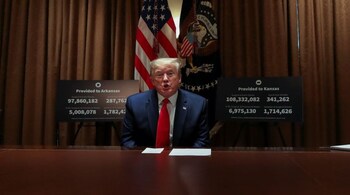
US President Donald Trump recently escalated his spat with Twitter by signing an executive order against the social media giant. The president’s feud with Twitter first began after the social media platform fact-checked one of his tweets regarding mail-in voting.
Twitter also flagged the president’s tweet that referred to people protesting George Floyd’s death as “Thugs” and called for military action against the protestors - “Any difficulty and we will assume control but, when the looting starts, the shooting starts.”
However, as outrageous as Trump’s tweets were, the First Amendment of the United States Constitution protects the right to freedom of speech. One would think that alone should be enough to justify Trump’s executive order, but that is not the case. And Trump’s order will likely make little to no difference. Before we get into the details as to ‘why’ this order is no more than a temper tantrum, let’s examine the order itself and Trump’s statements.
In a press briefing, Trump told reporters, “Today, I am signing an executive order to protect and uphold the free speech rights of the American people. Currently, social media giants like Twitter receive an unprecedented liability shield based on the theory that they are a neutral platform. My executive order calls for new regulations under section 2030 of the Communications Decency Act that ensure that social media companies that engage in censoring or any political conduct will not be able to keep their liability shield.”
If you are wondering whether this order has a leg to stand on; the simple and straight forward answer would be not really. That is not to say that Trump’s actions are not logical. As a social media company, Twitter is nothing more than a messaging service. Look at it this way; if you courier a package to an individual, the courier company does not open the package to check its content before sending it.
A social media company operates in the same way; it is nothing more than a middleman for people to share their expressions and thoughts. So when a social media platform starts censoring or deplatforming individuals and/or flagging, hiding or fact-checking tweets, it functions more like a publisher, because it is modifying content. As a messaging service, Twitter was not liable for the content posted by individuals or organisations as it only acted as a middleman.
This made it that no matter what was posted to Twitter, the social media company could not be held liable for the content. So now that Twitter is modifying content, fact-checking and flagging content, removing their liability protection is a logical move. People should have the right to sue you if you change their message.
However, is this really going to impact the way Twitter operates? The answer to that is a simple ‘no’. While getting rid of the liability shield will open Twitter to lawsuits; the company will likely win all of those suits as Twitter is a private company. And as a private company, Twitter does not have to be neutral.
The irony here is that conservatives are vehemently opposed to any kind of government regulation in the private sector. The capitalist market structure in the US that calls for little to no intervention from government in private companies is a conservative talking point. Twitter just happens to be one of those companies that have more left-leaning views and ideals, so the people they happen to censor or deplatform in many instances, happen to be conservative.
This makes Trump’s executive order no more than a complaint forum. People can complain all they want, but it is not going to lead to anything. So you can understand why this is nothing more than a temper tantrum by the US president. This is not the first time Twitter has deplatformed, flagged or censored right-winger or their viewpoints. But this is the first time that it has flagged Trump, and being the narcissist that he is, it was simply impossible for him to just let them off the hook. As a result of it, he resorted to the next best thing, a meaningless cheap shot.
The reason we say meaningless is because there are ways to properly manage private companies, the main one being regulating it like a public utility. This will give the government some authority to go after Twitter, in cases where the government deems it illegal to place restrictions on free speech. This would also give people the right to freedom of speech on the platform without any fear of being censored.
However, if Trump did pass this order instead of just removing liability protection, it would open up a whole new can of worms; starting with a national debate on whether all major private organisations should be treated as public utilities.
Take the gun industry, for instance; every time there is a mass shooting, which happens a lot in the US, any conversation about gun regulation is met with stiff resistance. Then there are drug companies who control the price of the life-saving drugs. People are often forced to travel to Canada, where a carton of insulin costs around USD 20 as opposed to USD 300 in the US. Those who are unable to make the journey, often ration their insulin, which leads to death in many cases.
The practices by these industries directly or indirectly lead to loss of life as opposed to simply shutting down the right to freedom of speech on one out of multiple platforms. So one would be able to make a solid case for government intervention in these sectors as well, something not just Trump but most of the Republican Party strongly opposes. This makes Trump’s executive order a temper tantrum more than anything else.
President Trump’s Twitter feud comes at a time when the country is facing massive levels of unemployment due to the COVID-19 crisis with millions of Americans unable to pay for basic utilities. Protests have also erupted across the nation calling for justice for George Floyd and seeking an end to police brutality, particularly against the black community.
Discover the latest Business News, Sensex, and Nifty updates. Obtain Personal Finance insights, tax queries, and expert opinions on Moneycontrol or download the Moneycontrol App to stay updated!





