

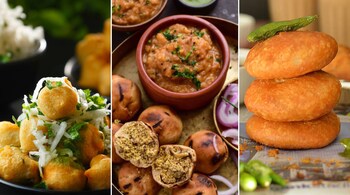
Most Indians believe that given the spiritual, religious and geographical proximity of Ayodhya and Varanasi, the food in the city of Lord Rama would be quite similar to that in the ancient city of Lord Shiva or Mahadev, where death is closely intertwined with life.
Food consultant, documenter and writer Sangeeta Khanna says that Ayodhya's cuisine influenced Lucknow’s vegetarian cuisine. In fact, the word Awadh is etymologically drawn from the Sanskrit word Ayodhya (which means irresistible). Once known as the granary of India, it was important strategically for the control of the Doab, the fertile plain between the Ganga and the Yamuna rivers. Now, it is known more for Awadhi cuisine, which we, erroneously, equate with biryanis and kebabs.
“The food in Ayodhya is far closer to Lucknow in its flavours than Banaras (Varanasi),” says Khanna, who grew up in the world’s oldest city and is known to be an expert in ‘Banaras ka khana’.
“Take kachori, for instance, which is a favourite street food across Lucknow, Varanasi and Ayodhya. In Varanasi, the kachori is thinner and larger, almost like a puri, and filled with yellow dal or lentils. You eat it with potato curry. In Ayodhya and Lucknow, it is puffed, round and thicker, and is eaten with channe ki dal (Bengal gram lentils),” says Khanna.
For breakfast, Ayodhya residents eat jalebi topped with dahi or yoghurt, which is served in a kulhad. “Their breakfast is jalebi and dahi or kachori and dal, or sometimes both,” says Khanna. The jalebi-dahi combo is also known as Vishwanath ki Jalebi, and a popular misthan bhandar (sweet shop) to eat it is the 75-year-old Maurya Mishthan Bhandar, which has won several National Association of Street Vendors of India awards.
Much of Ayodhya loves its chaat, says history buff and tour guide Ravi Maurya. “Chaat is a popular street cuisine and includes a variety of dishes such as papdi chaat and aloo tikki chaat,” he says. “Rabdi, another Ayodhya classic, is thick, full of saffron and cardamom or elaichi, and often paired with jalebi or malpua.”
He recommends eating fritters or pakodas freshly made at a shop called Gabbar Cholle Bhature and Chaat. “They make it fresh and the quality of the oil used is very good.”
How can a city, which Hindus believe to be Lord Rama’s birthplace, have nothing named after him? But if you were expecting a sweet or dessert, you will be shocked to find that Ram Laddu is anything but sweet. Ram Laddu is actually a savoury fried moong and channa dal fritter, topped with radish, green coriander, tamarind chutney, and lemon juice.
An Ayodhya speciality that the city has borrowed from neighbouring Nawabganj is Nawabganj Aloo or round, pebble-sized potatoes with a red skin and red flesh. “They are really expensive and often sell at almost Rs 200 a kilo. They are cooked in a covered pan without water and tempered with chillies and jeera or cumin seeds,” says Khanna.
Ayodhya worships Lord Hanuman with a passion that equals their devotion to Lord Ram. One of Lord Hanuman’s favourite food is Rhot, which Ayodhyavasis (residents of Ayodhya) offer to him as prasad.
Rhot, an indulgent combination of sugar, banana, flour and ghee, is made within homes but a few mithaiwalas also sell it from their stores in Ayodhya Chowk, which is where you get some of the best street food and mithai.
Much like Varanasi, Ayodhya winters aren’t complete without Makhan Malai, a light-as-cloud delicacy made with clotted cream, saffron and pistachios. There is peda, of course, made from condensed milk, khoya and sugar. The litti in Ayodhya is a stuffed wheat dough ball roasted over charcoal, which is served with smoky, mashed Chokha or vegetable mix.
Ayodhya’s residents end their day with a glass of milk boiled in a deep kadhai or pan till it is reduced to almost a quarter and covered with a thick layer of cream. Sometimes, they add sugar to it. “The malai wala doodh is made by the doodhwallas (those who sell milk) and not by halwais (the people who make desserts and sweets). In the evening, the doodhwalas put two kadais on fire. In one, milk is boiled and reduced. In the other kadai, they make rabdi with milk, cream, saffron and cardamom.”
While Ayodhyavasis like to drink the reduced milk at the doodhwala, they take very small quantities of rabdi home since they like to eat it fresh, rather than put it away in a refrigerator for another day.
Maurya says that at Ayodhya Chowk, mithaiwalas and doodhwalas adhere to age-old cooking traditions. However, throughout Ayodhya, one can find numerous snack shops and sweet stores.
Ayodhyavasis frequent establishments such as Maurya Misthan Bhandar in Shastri Nagar, Bajrang Mishthan Bhandar at Swarg Dwar, Thakur Mishthan Bhandar at Ayodhya Chowk, and the famous Gabbar Cholle Bhature and chaat shop.
Discover the latest Business News, Sensex, and Nifty updates. Obtain Personal Finance insights, tax queries, and expert opinions on Moneycontrol or download the Moneycontrol App to stay updated!





