

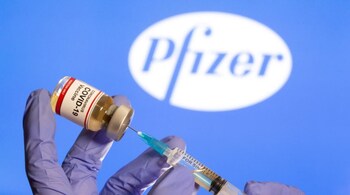
Pfizer has announced that it is beginning to test its COVID-19 vaccine in children younger than 12 years of age.
The company has already conducted a first-step study in a small number of young children to test different doses. Based on safety, tolerability and the immune response generated by 144 children in a phase I study of the two-dose shot, Pfizer said it will now test a dose of 10 micrograms in children between 5 and 11 years of age and 3 micrograms for the age group of 6 months to 5.
For the trial, the pharma company is ready to enroll about 4,500 young volunteers at more than 90 sites in the US, Finland, Poland and Spain. Enrollment of 5- to 11-year-old kids has begun this week, while that of children as young as 6 months will start in a few weeks, reported news agency Reuters.
Follow our LIVE blog for the latest updates of the novel coronavirus pandemic
Pfizer expects data from 5- to 11-year-old children in September, said a company spokesperson. Data for children 2 to 5 years old could arrive soon after that, he said. It expects to have data from the 6-month to 2-year-old age group sometime in October or November.
The vaccine made by Pfizer and its German partner BioNTech is already authorised for emergency use in children as young as 12 in the United States, European Union, and Canada. There, the children receive the same dose as adults -- 30 micrograms.
Nearly 7 million teens have received at least one dose of the vaccine in the United States, according to the US Centers for Disease Control and Prevention.
Also read | COVID-19 Vaccine Tracker: 27.7 lakh doses administered in India on June 8
Meanwhile, the trial of Covaxin -- India's first indigenously developed COVID-19 vaccine – has also begun in the country. The trial of the Bharat Biotech jab on children has already started at All India Institute Of Medical Science (AIIMS) Patna to see if the Bharat Biotech jab is suitable for children, while screening of children for trial has begun at AIIMS Delhi.
(With inputs from agencies)
Follow our full coverage on COVID-19 here.
Discover the latest Business News, Sensex, and Nifty updates. Obtain Personal Finance insights, tax queries, and expert opinions on Moneycontrol or download the Moneycontrol App to stay updated!





