

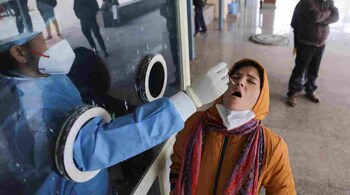
India recorded 8,148 new coronavirus cases in the week ending April 17, nearly 15 percent higher than the previous week’s count of 7,088, raising concerns about a possible fourth wave in the country.
In the week gone by, active infections in the country, too, rose nearly 5 percent. The trend is in sharp contrast to the swift decline in new cases and active infections that was being seen since the end of January.
The increase is particularly noticeable in three states—Delhi and its neighbours Haryana and Uttar Pradesh. The national capital reported 517 new cases on April 17, the highest since February 20.
The test positivity rate—the percentage of positive results among all tests performed—for Delhi has also climbed to more than 4.61 percent after remaining well under 1 percent for several weeks.
In UP and Haryana, the rising cases are mainly being reported in Gautam Budh Nagar (Noida), Ghaziabad and Gurugram—the districts adjoining Delhi.
What is causing concern is the uptick in infection among children, a majority of whom have returned to school after almost two years.
It is being speculated that the rise in cases may be due to yet another sub-lineage of Omicron, possibly XE variant which is a combination of BA1 and BA 2 subvariants but it is yet to be confirmed by the country’s COVID-19 genomic surveillance project INSACOG.
Experts watching the numbers say it may be too early to say if the escalation is a sign of yet another major surge. They also point to the fact that BA 2, more transmissible than BA.1 subvariant, has been the dominant Omicron variant in India since January.
“I would say it is a bit too early to suggest the beginning of a new wave yet,” said health economist Rijo M John. “I would give it a couple of days to see if the surge sustains or escalate before we can say anything significant”.
The mask is slipping
The surge seemed to be a result of no-mask practice coupled with free mass gatherings, Dr Pragya Yadav, senior scientist with the National Institute of Virology-Indian Council of Medical Research said.
“Whether or not there is another variant of concern, we should be patient in avoiding crowds and continuing to adhere to COVID-appropriate behaviour,” she told Moneycontrol.
Beginning April, Delhi, which faced a devastating second wave in the summer of 2021, and the financial hub of Mumbai, which, too, suffered in the first as well as the second wave, made wearing masks in public voluntary.
Though the mask mandate is in place in Haryana and Uttar Pradesh but it is largely being ignored.
Another scientist attached with a government institute, too, said the rising graph suggested waning immunity.
Lack of public health measures such as masks, physical distancing and ventilation could be the reasons for the changed epidemiological pattern, the scientist, who didn’t wish to be identified said.
“Such rise in cases will happen with or without variants every six to eight months,” he said.
“So, it is a good time to revisit public health measures as a habit to learn to live with COVID19. Also, it needs to be emphasised that the vulnerable- elderly and people with comorbidities need the protective coverage with precautionary doses of COVID-19 vaccine.”
Dr Rajeev Jayadevan, a public health expert from Kerala who is also a state Indian Medical Association (IMA) COVID-19 task force member, said a large number of people were thinking that the pandemic had gone away and precautions were no longer necessary.
“This has to be urgently addressed,” he said.
No change in hospitalisation pattern, yet
In Delhi, where the coronavirus numbers are showing the sharpest rise, only 0.68 percent of the dedicated COVID-19 hospital beds were occupied on April 17, the statistics released by the state government showed.
Also read: Rise in COVID-19 cases forces many Delhi-NCR schools to shut but experts allay fears
Rijo M John, too confirmed that while daily cases were rising in the three states, there was no indication of either hospitalisations or deaths going up, so far.
Hospitalisation may not be a reliable parameter in the early stage of a wave, Jayadevan cautioned.
“That’s because there is a lag before the infection reaches vulnerable people, and takes further time to cause fatal complications,” he said. “Therefore, careful follow-up will be necessary.”
Jayadevan said though individual mortality was low, the virus could incapacitate large numbers of people at any given time.
He cited the example of Ontario, Canada where hospitals are facing not only an increased load of patients but also a severe healthcare worker shortage because of COVID-19 sickness.
Living with the virus
A recent study in the Lancet Infectious Diseases journal said older people who were vaccinated were two times more likely to carry the virus silently, as the vaccines were not targeted at preventing infection or transmission but only disease severity, Jayadevan said.
“This means that the virus is able to get through to people through increased social mingling,” he said.
Dr Amitav Banerjee, an epidemiologist based in Pune, stressed that the panic around SARS CoV 2 needed to subside.
Also read: New coronavirus variant XE: Does India need to worry?
“The present cases due to mutations of the virus rendering it milder can be considered as common colds with a fancy name,” he said. “In my view, further dissemination of such mild variants will raise the population immunity levels still higher, with negligible casualties achieving what vaccination could not achieve in many countries with very high vaccination coverage.”
Discover the latest Business News, Sensex, and Nifty updates. Obtain Personal Finance insights, tax queries, and expert opinions on Moneycontrol or download the Moneycontrol App to stay updated!





