

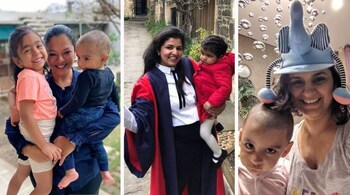
By Hem Borker, Kadambari Rana, Samrata Salwan Diwan
The three of us became close friends while studying at St Stephens College, Delhi. Never had we imagined spending a large part of our 30s discussing the joys and sorrows of raising kids. Now, with the COVID-19 lockdown, staying safe and sane has been the single most challenging job for all of us.
We have donned big smiles from dawn to dusk, when we wanted to shout our lungs out instead! What do you do when play areas, parks and schools are shut down, but the ‘powerhouse’ inside of a growing child isn’t? You transform into overactive, insatiable little monkeys yourselves!
We share our plight and some tips that we hope other mums will find useful.
HEM BORKER
After completing my Master’s, I did my doctorate in education from the University of Oxford. But once I became a mother, I realised it was nothing like doing a Ph.D, irrespective of the analogies seniors and university professors gave. I feel my next book project is more likely to be based on ‘motherhood’ rather than on my thesis.
I currently teach gender, education and social exclusion at Jamia Millia Islamia. Owing to the lockdown, I have to race against time to complete my online class schedules as well as offline schedules with my three-year-old daughter Avya and 18-month son Adyapat.
While my children are discovering the joys (and sorrows) of being full time with their mom for the first time, I often have a tough time explaining my profession to my daughter who wonders aloud why my students are so ‘big’, why they call me ‘doctor’, and what kind of doctor am I?
Being a work-from-home mother is a new challenge. How do I explain to my little children that “mom is (physically) there, but she is really not available”. I had to make some tough choices to do justice to my role as a mom while also pursuing an independent career. Over time my daughter has understood that mom has ‘online’ office just like she has ‘online’ school.
I’ve learnt to make everyday moments ‘together time’ with the children – from dressing up in the morning, to reading stories and doing craft-work related to it at night. We play musical chairs, dance-and-freeze, I-Spy and obstacle races with hoopla rings. We have also created a slide and sandpit in our garden.
I am the eternal planner and none of my plans ever worked out. I’m grateful to the kids for the gift of patience and for realising that I have a lot to be thankful for because we spent today safe, healthy, together.
KADAMBARI RANA
I did my M.Sc in economics from Cardiff University in the UK, and went to work as a research associate in ‘integral education’ at Sri Aurobindo Society, Pondicherry. Next, I taught economics at my alma mater, The Shri Ram School, Delhi. At 35, in my current role as a mother to my two-year-old daughter Sanghamitra, I spend most of my time in providing the necessary support structure for my daughter’s growth.
As women, we become more inclined towards ensuring the well-being of our entire ‘family jing-bang’, which often slows us down in our own professional lives. However, it is important to not lose sight of our innermost aspirations.
I trust myself to be able to use limited resources to generate enjoyable learning time. However, a large part of the activity timetables, even for me, was dependent on external factors such as places to go, people to meet, or things to be sourced, which I have no more control over in the lockdown! I admit I experienced my fair share of anxiety and panic.
The first thing I learnt was to let go of some of my own ‘rules and regulations’. The world is upside down and we need to adapt. Let them hang on to the telephone cords, give them a wall to scribble on, let them make water puddles on the glossy floors, let them stick stickers on toilet seats, party and groove on their favourite nursery rhymes, make character masks and do drama and theatre at home, let them roll in mud and sand, read lots of stories together and just let them ‘skip, hop and jump’ around the house.
This is also a good time to inculcate dignity of labour and honing life skills. My two-year-old assists us in laundry, cleaning and gardening. Other family members also take over learning or activity time with her, so that she can develop a bond with each of them.
SAMRATA SALWAN DIWAN
After completing my post-graduation in international relations from SOAS, University of London, I set up Family Fables Co, a bespoke publishing company documenting family and institutional histories. More importantly, I am mother of Gayatri, who is four and a half years old, and Viraj who has just turned one. I divide my time between Delhi and Shivpuri in Madhya Pradesh and hustle between mama duties.
Home-schooling kids during the lockdown and adapting to the new online format of school is something new, not only for the children but also for their parents. In the pre-lockdown era, I had begun to get a small ‘work window’ while my daughter was at school, which now no longer exists.
Sheryl Sandberg rightly put it, “The coronovirus pandemic has created a ‘double double shift’ for women.” Working women were already doing a ‘double shift’, pursuing their careers and then returning home to take over childcare and housework. But the current situation is created a ‘double double shift’ type problem for them.
I have survived so far by creating a routine and sticking to it, especially sleep and meal times. I also get kids to help in the household chores. For exercise, we dance and do yoga or a combination of storytelling and yoga. Gardening is another hands-on and creative activity. We also play board games like Ludo and Snakes & Ladders. The kids miss meeting their friends, so we help them socialise via WhatsApp video calls and Zoom calls.
Discover the latest Business News, Sensex, and Nifty updates. Obtain Personal Finance insights, tax queries, and expert opinions on Moneycontrol or download the Moneycontrol App to stay updated!





