

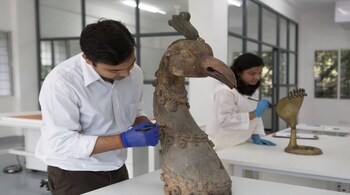
A canopy over him, the tirthankara sits cross-legged in the bronze sculpture that Bengaluru-based Paromita Dasgupta has been studying closely for the past few days. The faces of those surrounding the Jain monk have become blurred over time, and yet, as Dasgupta interacts with the sculpture with careful, gloved hands, it reveals more of itself. Only days before, the tiny rock crystals on its grooves remained hidden, tucked away and out of sight.
There was no trace of these embellishments when she first saw this sculpture. “There’s often more to something than what meets the eye. The more you interact with it, the more you peel away layers, the more you find out about it,” says Dasgupta. A conservator and restorer with the Museum of Art & Photography (MAP) in Bengaluru, Dasgupta has spent a better part of the last five years doing just this – rediscovering the true form of artworks exposed to the vagaries of weather and time.
Dressed in lab coats, the team of conservators and restorers at MAP, when not directly working on a piece of art, spend their time studying and documenting a wide range of artworks. Mediums of these artworks vary from metal and wood sculptures to works on paper, canvas, or crafted out of terracotta. They work with ceramics, too.
Dasgupta’s personal fascination with museums dates back to the time her family would spend their vacations touring these keepers of history and culture. Originally from Assam, one of the defining moments of her time was when she first saw the Egyptian mummies on display at the Indian Museum in Kolkata. Ruminations on what it would take to preserve these fragile and centuries-old artifacts sent her down a path of making a career in conservation.
On one of the tables behind her lies an old Madhubani painting, carefully spread out to check for tears and remove the creasing that the work has developed. Each task attended to is a gift to her former self, a child thrilled by sights that remain safeguarded behind glass cases.
Before the sculpture of the Jain monk made its way to the large tables in the Conservation Centre at MAP – a white-walled 'laboratory' with state-of-art equipment such as specialised microscopes and fume extractors – Dasgupta would spend her time on two wooden sculptures. One of these showcases Ganesh, the other has Karthik. Both deities have apsaras on either side on the sculptures. These are dated mid to late 19th century. Bits of the sculptures had suffered loss of wood material, and Dasgupta and her colleagues at MAP have been tasked with bringing these pieces closer to what the artist’s original work was.
Spread across mediums, over 200 works of art have been restored at MAP’s Conservation Centre, a project supported by Tata Trusts. MAP is one of the few zonal institutes partnering with the Tata Trusts Art Conservation Initiative. The Mehrangarh Museum Trust in Jodhpur, the Himalayan Society for Heritage & Art Conservation in Nainital, Anamika Kala Sangam Trust in Kolkata, and the Chhatrapati Shivaji Maharaj Vastu Sangrahalaya in Mumbai are some of the other institutions Tata Trusts is working with.
A museum for the people
Scheduled to open in 2021, MAP is spread out over four floors on Bengaluru’s Kasturba Road. It is expected to be south India’s first major private art museum. A custodian of a growing collection of works which are predominantly from the Indian subcontinent, the artworks in MAP’s safekeeping date back to the 10th century.
MAP is situated across the road from the Government Museum and Visvesvaraya Industrial and Technological Museum, making this corner of the city a ‘museum hub’ when it opens its doors to the public. Besides the restoration facility and multiple galleries, MAP also has an auditorium, an education centre, and an art and research library.
MAP’s collection of artworks is split into six key categories: modern and contemporary art, photography, folk and tribal art, popular culture and textiles, craft and design, and pre-modern art. An undated portrait of Gandhi by Jamini Roy, among the most famous pupils of artist Abanindranath Tagore, and a floral-decorated faience serving dish, dated mid-20th century, are among the works that have been recently restored at MAP.
These restored works are largely from MAP’s collection and date back to the 17th century. “Going forward, we may also be able to cater to external collectors thus becoming south India’s hub for restoration,” says Kamini Sawhney, director, MAP.
Not a DIY project
The process of restoration and conservation has gained fresh momentum in the global art circles after a copy of “Immaculate Conception” by Spanish artist Bartolomé Esteban Murillo, owned by a private collector, went in for a cleaning to an amateur. It emerged so botched beyond repair that the incident triggered a call for restoration laws to be tightened in Spain. The original saw the artist highlighting Mary’s cherubic face as she floated, hands folded together, in a backdrop of cherubs. In the “restored” piece, her face resembles an oval-shaped potato. This incident is only one among many the many botched restorations across the globe.
But the process of restoration can in itself be a thing of beauty, a soothing, calming display of how things can be put back together. Second generation art restorer Julian Baumgartner’s YouTube videos which show him navigate the delicate process have built up quite a following for this very reason. In some ways it’s a reminder of the ancient Japanese art of Kintsugi, where things once broken become more precious after they get a fresh lease of life.
In the Indian context, the need for MAP’s restoration project, says Sawhney, comes from the fact that India faces a shortage of skilled professionals in the field of art conservation, and every year the country loses a significant amount of its heritage. “One of the primary responsibilities, as a museum, is to look after our collection, in turn contributing to the preservation of Indian art,” she adds.
Each medium brings with itself new challenges, demanding a different approach as the work waits to be made whole again. Paintings on paper can see the paint flaking off over time. Paper can also tear, develop splits and stains; oil paintings on canvas slowly darken over time owing to the layers of varnish meant to protect them. Sometimes artists use layers of varnish, and these layers can also develop cracks. Wooden sculptures too develop splits, cracks and rots, iron ones face the threat of rust, and works fashioned out of copper develop bronze disease which leave behind green coatings.
Tools of trade
Not too long ago, Dasgupta had in her hands a brass hammered dish, depicting a scene from the Ramayana. This foliate rim dish showcased Ram, Lakshman and Sita walking while Hanuman and Jatayu dance below the three walkers in a backdrop replete with flowers.
Utilising the repousse technique used to decorate metals, where pencil-like steel rods, hammers and chisels help create relief features by pushing the metal in (or out), the brass dish required minimal intervention to bring to light the original artist’s creation. Among other things, minimal intervention helps gives a context of the sensibilities of the time the work was created in.
It’s common for people to interchange the terms conservation and restoration, says Dasgupta. If a hand in an oil painting goes “missing” over time, arresting the damage done by time and weather to stop the deterioration process would be conservation. Painting a fresh hand to increase its aesthetic value would translate to restoring the piece. One point to be taken into consideration while restoring an object is the compatibility of materials used: the paints required, for instance, would need to be the closest in shade to the original piece as previously documented through photographs.
And even after a piece has been restored, it requires periodic monitoring of not just the work in itself, but also the conditions in which the art work is kept, including the temperature and relative humidity of the room. Keeping in mind that all these things require specialisation, and thus the detail-oriented, time-taking work of looking after art requires people from backgrounds as diverse as fine arts and sciences. “The job remains an inter-disciplinary one to keep things running smoothly,” says Dasgupta.
The restored collection of artworks will be the central focus of MAP’s exhibition programmes once the space opens up its doors to the public. And like in Dasgupta’s case with the mummies, perhaps these restored works could pave the way forward for India’s next generation of conservators and restorers, the next line of keepers of our history.
Nikita Puri is a journalist based in Bengaluru.
Discover the latest Business News, Sensex, and Nifty updates. Obtain Personal Finance insights, tax queries, and expert opinions on Moneycontrol or download the Moneycontrol App to stay updated!





