

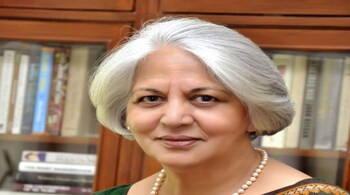
Breaking Through (2020), a memoir by Isher Judge Ahluwalia, is an intimate record of economic policymaking in post-Partition India. The author achieved tremendous success as a scholar and institution builder, and this book offers an account of her journey from being one of 11 children in a family with limited means to becoming an economist of international repute. Ahluwalia’s narrative voice is neither self-indulgent nor self-effacing. She has crafted a richly textured first-person narrative that would be of interest to economists and generalists.
She passed away on September 26, 2020, shortly after this book was released. Much of it got written during the early months of the COVID-19 pandemic. She mentions, “I knew that the rest of my life could well be spent under lockdown. My age, and the brain tumour, meant I was highly vulnerable.” Towards the end, she found it difficult to read and write on her own. Her husband Montek Singh Ahluwalia -- former Deputy Chairman of the Planning Commission of India -- “would take dictation, type out the chapters, sit and read them out to me, write out my corrections in hand, and work them into the typed version.”
Writing this memoir, published by Rupa, helped the author revisit each phase of her life and reflect on how all the pieces came together. It is moving to read about the determination and resourcefulness it took to cultivate her intellectual gifts, especially because she grew up in a family that “viewed academic life with somewhat sceptical bemusement.” After graduating from Presidency College in Kolkata, she managed to convince her parents to let her study at the Delhi School of Economics (DSE) on a scholarship. It was a dream come true.
Ahluwalia does a fine job of connecting personal milestones to the political climate. She moved to India’s capital in 1965, a year after Prime Minister Jawaharlal Nehru’s death. During her time at DSE, “the economy was reeling under the effect of drought; the Fourth Five-Year Plan had been postponed; India was just recovering from a war with Pakistan; and the relationship with the US, on whom we depended for food and other aid, was becoming very complicated.” Prime Minister Lal Bahadur Shastri died while negotiating a peace agreement in Tashkent. Prime Minister India Gandhi took over, and the rupee was devalued under her leadership.
The author’s candour throws light on the inner workings of the higher education system in India. She is particularly critical of “the glaring gap between the cutting-edge research pursued by my professors and what they taught us in the classroom.” Her disappointment comes from the fact that students were taught economic theory in the classroom but kept insulated from the major policy debates that “several of our professors were leading participants in.” She found it hypocritical that “they were constrained to regurgitate received wisdom for their students in the classroom” rather than integrating their world-renowned scholarly critiques into their teaching.
This book provides valuable insights into the pedagogy of economics. Pursuing a PhD at the Massachusetts Institute of Technology (MIT), where students “were encouraged to think originally, even if it differed from the professor’s known positions,” made Ahluwalia realise that DSE was quite traditional. She recalls how students were “not made aware of the debilitating impact of our import substitution policies on our exports.” Moreover, two DSE professors, K. N. Raj and Jagdish Bhagwati, who had advised Mrs. Gandhi in relation to the devaluation of the rupee, had failed to use that crucial teaching moment in the classroom.
The author makes a strong case for the power of mentorship by showing how the academic training she received at MIT, particularly from Paul Samuelson who won the Nobel Prize in Economics, prepared her to take on big responsibilities. She interned with the Population Council in New York, and worked with the International Monetary Fund in Washington DC, before returning to Delhi along with the man she fell in love with and decided to marry. Here she became a professor at the Centre for Policy Research, and director (later, chairperson) of the Indian Council for Research on International Economic Relations (ICRIER).
This book reveals that Ahluwalia did not shy away from speaking up when she faced gender discrimination at work, flak from left-leaning colleagues for her championing of liberal ideas, or unnecessary interference from Americans who were not in touch with the ground realities of South Asia. She wanted economic think tanks to be more than “quasi-captive research outposts of government ministries.” Therefore, she made a special effort to involve NR Narayana Murthy, Uday Kotak and Kiran Mazumdar Shaw in ICRIER’s work.
“Some of our brightest business people stay away from the world of policy...they associate it with Delhi and red tape,” she says. Her memoir has much to offer younger economists who wish to make a difference where it counts. Apart from detailing her professional trajectory, it also illuminates how she made gentle and firm negotiations in every aspect of her life, balancing idealism with pragmatism, and carving out a niche for herself.
(Chintan Girish Modi is a writer, educator and researcher who tweets @chintan_connect)
Discover the latest Business News, Sensex, and Nifty updates. Obtain Personal Finance insights, tax queries, and expert opinions on Moneycontrol or download the Moneycontrol App to stay updated!





