

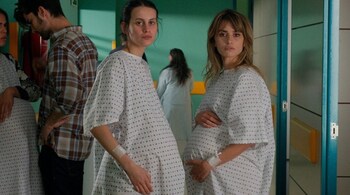
I am a veteran ‘One-Who-Stare-Unblinking-At-Screens’ ever since I first saw Penelope Cruz as Silvia seducing not just me, but the entire theatreful of people watching Jamon Jamon. Hated her for a while when she was married to Javier Bardem (they appeared together in Jamon Jamon, Vicky Cristina Barcelona, Everybody Knows, and even Loving Pablo), but then every time she appears on screen, you forget everything but the character she is playing.
Pedro Almodovar is hugely responsible for creating the magnificence that is Penelope Cruz. They have 11 movies together. In any case, as Antonio Banderas has said, ‘Even if Almodovar offers an actor a tiny role, they should just take it, because he makes it great.’
That said, Penelope Cruz as the photographer Janis Martinez in Madres Paralelas or Parallel Mothers is possibly her best role yet. The film begins with Janis taking photographs, giving instructions to the man in front of her. But in the darkness of the theatre, you will start reacting to the instructions ‘lower!’, ‘slight smile’, ‘hold it!’ not once taking your eyes off the woman sitting on the floor taking pictures.
She’s having an affair with a married man, and is pregnant by him. In Bollywood, this would have been a huge thing even today. Janis simply decides to have the baby and in the delivery room meets with another woman who is about to give birth. As strong as Janis is, in contrast is Ana (played with ridiculously amazing sensitivity by Milena Smit) a teenage girl who has come to the hospital with her mother. Each gives birth to a daughter and you’d think why would we see this as a story?
But if you have grown up watching Hindi movies, you’ll be like Arturo, Janis’s love, who knows instinctively that the baby (be ready to coo and ooh and aah over the baby on screen!) looks nothing like him. He puts the idea into Janis’s head that this baby was may not be his. You think Manmohan Desai has used this trope years and years ago. And you want to forget that you watched a ghastly Bollywood comedy made out of a baby swap as in Good Newwz.
But the mastery of Almodovar comes in when Janis realises that the baby she has loved is not hers. When Ana shows up, you wonder what Janis is going to do now. Will they swap babies again and love them anew? You want to know if Janis will confess to Ana that the babies were swapped? The two women come from circumstances that are as radically different and yet we fall in love with both these women. Your heart goes out to the mother who has lost her baby to crib death (one of the biggest factors of infant mortality), as also to the one who knows that the baby sleeping on her tum is not hers.
The interaction between the two, and the ease with which the events unfold will make you reach out for a tissue box you have packed in your bag. Pedro Almodovar’s gentle touch about motherhood and his fierce lens covering the issue of a woman’s right to her body is unparalleled. But there’s also a bold political statement that is present in the movie. Just as you cannot cage motherhood and women, so can you not leave the dead unless their dignity is restored. Janis and Arturo are at her ancestral village and they’re at the site of an excavation. It breaks your heart to see the rattle Janis’s grandfather used to distract her with when the militia was on a killing spree in the village.
Spain’s monarchy has come under a lot of scrutiny in recent years. The extreme religious right believes in archaic rules laid down by the Christian Rota (a lot like our village Khap Panchayats), and women are often at the receiving end of patriarchal laws laid down. As an excavation of the skeletons happens in the village, we see Janis hugging the baby she thought was hers for the last time. Ana leaves with her baby and the skeletons find their form. This could have been horrid and harsh at the hands of a less seasoned director, but as the lights come on, you sit there stunned, your heart wrung by Janis’s pain, Ana’s rediscovery of motherhood, the history that has emerged from the pit.
You don’t want to join any conversation about which Penelope Cruz roles are best. You don’t want to talk about the predominantly red palette that Almodovar’s films often use. You don’t want to admit that you wondered why Janis needed to see negatives of film when she was using a digital camera… You don’t even want to tell people that you love the houses in Madrid that Almodovar finds to shoot his films in. You don’t want to remember that in the film Broken Embraces, you spotted the poster of Parallel Mothers. You know you are looking forward to Tilda Swinton as The Human Voice in Almodovar’s next short film as also A Manual For Cleaning Women which is going to be the director’s next film. The orchestral music with the viola and the double bass from this salute to motherhood and femininity is still reverberating in your head.
Discover the latest Business News, Sensex, and Nifty updates. Obtain Personal Finance insights, tax queries, and expert opinions on Moneycontrol or download the Moneycontrol App to stay updated!





