

The most striking scene in Joram arrives just after the interval. An intimate recreational evening organised for a city-bred Mumbai cop who has just arrived in Jharkhand, quickly devolves into an unglamorous parade of toxicity and social oppression. This is one of director Devashish Makhija’s most beloved cinematic tools, a dynamic light-and-sound exhibition of rowdy men, thrusting pelvises and the political nuance it proverbially obliterates. It’s been a regular fixture in all his films, except this time round, it pushes the envelope in a manner that elevates a familiar sequence into the orbit of memorabilia. It’s just one of the many scenes that stick with you, long after Joram has finished. Grim, unsparing and unconventionally gritty, this film led by the exceptional performances of Manoj Bajpayee and Mohd Zeeshan Ayyub, is a stunning analysis of tribal displacement and majoritarian narratives.
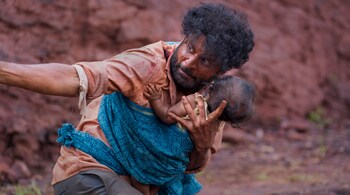
Bala (also known as Dasru), played by Bajpayee, is a tribal from the forests of Jharkhand, who works as a daily wage labourer at one of Mumbai’s many construction sites. From an actual jungle, Bala, along with his wife and newly born son Joram, has moved to the concrete jungle of the metropolis. It’s not just the airy freshness of the wild that he left behind but a sordid history too. On his heels is Phulo, played by the terrific Smita Tambe, a tribal leader from the village where Bala was once a reluctant rebel against national rule. Phulo wants to settle a score. She is an unruly, but lonely widow, the living embodiment of the dilemma that presents itself to tribals who crave both development and cultural authenticity. After Bala is framed for the murder of his wife in the city, he escapes to his village to ask for forgiveness. He is followed back into the hinterland by Ratnakar, a Mumbai-raised cop played with suave minimalism by Mohd Zeeshan Ayyub. It’s through Ratnakar’s eyes that we actually see the tribal landscape unfold as a site of woe, misery and generational injustice.
Also read: Manoj Bajpayee: Every character leaves some injuries on your subconscious
A straightforward police v criminal chase is merely the language of encryption for the message underneath here. The word ‘Naxalite’ is a loosely used term for the political spatter of ownership and environmental imperialism. Though it is kindled in the city, Joram firmly settles into a sparkling, if uneasy, rhythm when it enters the arid landscape that Bala ran away from. This is where it all started, we are told through flashbacks. The film makes it a point to affirm its politics. Some of it rather excitedly, some by cautiously mixing it into the sand of the film’s narrative castle. There is an image, where Bala while on the run, feeds Joram in front of a stony fixture with the Constitution writ large over it. It’s unsubtle, but also keeping in line with the film’s bold embrace of a thorny, unsolvable argument. Men and women, therefore, resent having to give up their farmlands as much as they also mourn the death of their soil. Something must give and it does in the way of anger, dejection and violence.
Also read: Making of Joram: Manoj Bajpayee, Devashish Makhija & a big studio make the subaltern run
It’s incredible that every time Manoj Bajpayee does something these days, it feels like a career-best performance. Here, he is the hysterical, overwhelmed father, manically chasing a moment of relief. It’s as much a physical role as it is testament to Bajpayee’s peerless ability to internalise conflict. Few actors working today can pull off the dishevelled trauma that Bajpayee carries here without condensing it into a typically masculine response. He simply crumbles by the minute. But this film won’t be what it is without an equally chastening and affecting performance by Ayyub as the tired officer, who looks defeated by the speculative task of finding a moving needle in a haystack of historical suffering and dehumanising status quos.
Both, the person chasing and the one being chased are bottom-feeders, footnotes to the summary of power and agency. Their worlds meet only to realise that they are in fact, rather mockingly, indistinguishable. Displacement for some begins at birth. The rest of life is merely spent running away from being found. Some do it in civil clothes, some in airbrushed uniforms.
Makhija’s third film is easily his finest. It has its problems with a frisky, rather abrupt way of shifting the narrative from the city, but once it’s back in the heartland, musing over the sights, breathing in what feels like economic purgatory, and trying for the sake of the awestruck observer to make sense of why something seemingly calm and pristine must be saddled with grief and blood, that it really becomes absorbing. Joram owes everything to the spectacular performances of its ensemble cast, the capable direction and writing that allows the audience to blankly absorb the imagery, without unnecessarily over-explaining the motifs. It’s moody, raw, a bit too prompt but satisfyingly moving. All because it is anchored by two exceptional performances that urge you to reconsider the margins, as the centre of a kind of social paralysis.
Discover the latest Business News, Sensex, and Nifty updates. Obtain Personal Finance insights, tax queries, and expert opinions on Moneycontrol or download the Moneycontrol App to stay updated!





