

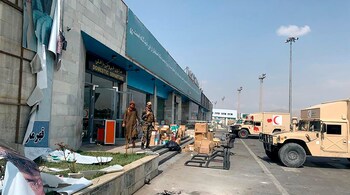
On August 30, the United States completed its troop withdrawal from Afghanistan after two decades of military operation. Over these 20 years, the US deployed more than 775,000 troops to Afghanistan and spent $145 billion to rebuild the war-torn nation, its security forces, civilian government institutions, economy, and civil society, according to the Special Inspector General for Afghanistan Reconstruction (SIGAR).
“It’s a mission that brought Osama bin Laden to a just end, along with many of his Al Qaeda co-conspirators,” General Kenneth McKenzie, commander of US Central Command said while announcing the completion of the withdrawal. “It was not a cheap mission. The cost was 2,461 US Service members and civilians killed and more than 20,000 who were injured. Sadly, that includes 13 service members who were killed last week by an ISIS-K suicide bomber. We honor their sacrifice today as we remember their heroic accomplishments.”
In addition, warfare has cost $837 billion for the US defence forces and left over 1,100 allied troops dead. Even the Afghans had to bear high losses with at least 66,000 troops killed, over 48,000 civilians dead and nearly 75,000 injured since 2001-- both likely significant underestimations.
In 2011, the then US President, Barack Obama, announced that all surge troops would be out by 2012. However, a year later he declared that “the defeat of Al-Qaeda was within reach,” and the strategy would focus on training Afghan forces and combating terrorism.
Between 2012 and 2016, a 63 percent drop in US military assistance and a 72 percent drop in US civilian assistance was reported. The process did not go well as expected.
“Contested territory that had been cleared by U.S. forces was hastily ‘transitioned’ to Afghan officials who were not ready, allowing the Taliban to seize districts as U.S. forces vacated them,” states the SIGAR report released in August 2021.
As years passed, since about 2018, the Afghan government started losing control of additional (16 percent) areas in the country. In 2021, with the US government declaring its final withdrawal, the Taliban was quick to respond by seizing “more than a quarter of the country in a matter of weeks,” as the Afghan forces jilted their positions or were occupied, the report notes.
“The ultimate point of failure for our efforts wasn’t an insurgency. It was the weight of endemic corruption,” according to Ryan Crocker, a retired diplomat and former ambassador to Afghanistan.
“It became increasingly apparent that Afghan officials themselves were corrupting reconstruction efforts, exacerbating conflict, and driving many Afghans into the arms of the Taliban. Prosecuting these officials, or even removing them from office, proved extremely difficult, since it would mean ‘dismantling major pillars of support for the government itself,’ including its electoral institutions,” the SIGAR report adds on to the statement by the former diplomat.
In terms of rebuilding and reconstruction of the war-torn nation, the US spent nearly $7.8 billion on capital assets such as buildings, transmission lines and substations, roads and bridges, motor vehicles, and aircraft. Of this, nearly 31 percent, or $2.4 billion worth of assets, were not being used as planned or had been abandoned or destroyed, according to the SIGAR report.
Health care, maternal health and education were among the notable areas where the US attempted to help, assist and improve but all of this now seems in vain with the Taliban taking over.
A vulnerable stockpile
The swift and surprise takeover of Afghanistan by Taliban, and what seems a forced eviction of the US forces has resulted in the latter leaving behind a huge stash of arms in the hands of rogue elements and terrorists.
Over the years, the US government has provided an estimated $83 billion worth of equipment and training to Afghan security forces. This year alone, the US military aid to Afghan forces was $3 billion, Forbes reported. Most of this is now feared to be under the control of Taliban and allied non-state actors taking charge of the country.
Security experts view the US withdrawal and return of Taliban as a boost to global terror.
“By empowering the Taliban, Biden has strengthened all jihadi groups, promising the rebirth of global terrorism,” wrote Brahma Chellaney, strategic thinker and author in the Nikkei newspaper. “And by betraying one ally -- the elected Afghan government -- he has made other U.S. allies feel that they too could be betrayed when they most need American support. Nowhere will the U.S. costs for its Afghanistan blunder be more visible than in Asia, where an emboldened China is set to up the ante.”
Discover the latest Business News, Sensex, and Nifty updates. Obtain Personal Finance insights, tax queries, and expert opinions on Moneycontrol or download the Moneycontrol App to stay updated!





