

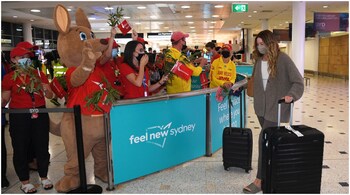
International tourists and business travelers began arriving in Australia with few restrictions on Monday for the first time in almost two years after the government lifted some of the most draconian pandemic measures of any democracy in the world.
Vaccinated travelers were greeted at Sydney's airport by jubilant well-wishers waving toy koalas and favorite Australian foods including Tim Tams chocolate cookies and jars of Vegemite spread.
Federal Tourism Minister Dan Tehan was on hand to welcome the first arrivals on a Qantas flight from Los Angeles which landed at 6.20 am local time.
"I think there'll be a very strong rebound in our tourism market. Our wonderful experiences haven't gone away," Tehan told Australian Broadcasting Corp. television.
Home Affairs Minister Karen Andrews said all travelers' vaccination status would be checked before they arrived to avoid a repeat of Serbian tennis star Novak Djokovic's visa debacle.
Djokovic was issued with a visa through an automated process before he left Spain to compete in the Australian Open in January but was deported after he arrived in Melbourne because he was not vaccinated against COVID-19.
Tourism Australia managing director Phillipa Harrison said she expected tourist numbers would take two years to rebound to pre-pandemic levels.
"This is a really great start," Harrison said. "This is what the industry had been asking us for, you know, just give us our international guests back and we will take it from there."
Qantas on Monday was bringing in passengers from eight overseas destinations including Vancouver, Singapore, London, and Delhi.
The Sydney-based airlines chief executive Alan Joyce said bookings had been strong since the federal government two weeks ago said that the country was relaxing restrictions.
"It has been tough two years for everybody in the tourism industry, but today is really one of the big steps on the way back to a full recovery so we are very excited about today," Joyce told Nine Network television.
Prime Minister Scott Morrison said 1.2 million people had visas to enter Australia with 56 international flights due touch down in the first 24 hours of the border reopening.
Australia imposed some of the world's toughest travel restrictions on its citizens and permanent residents in March 2020 to prevent them from bringing COVID-19 home.
Travelers had to apply for an exemption from the travel ban, but tourism wasn't an accepted reason. International students and skilled migrants were prioritised when the border restrictions were relaxed in November in response to an increasing vaccination rate among the Australian population. Tourists from New Zealand, Japan and South Korea were also allowed in early.
Australian states and territories also have their own COVID-19 rules; the strictest are enforced by Western Australia state, which covers a third of the island continent.
Discover the latest Business News, Sensex, and Nifty updates. Obtain Personal Finance insights, tax queries, and expert opinions on Moneycontrol or download the Moneycontrol App to stay updated!





