

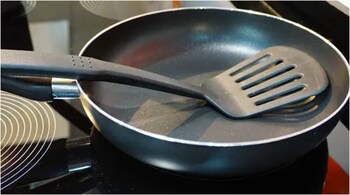
The past year has seen a significant increase in reported cases of polymer fume fever in the United States, a rare illness caused by inhaling fumes from overheated nonstick pans. According to the Washington Post, US poison centres documented 267 suspected cases in 2023, one of the highest numbers recorded since 2000, New York Post reported.
Often referred to as "Teflon flu," polymer fume fever is named after the trademarked nonstick coating, Teflon, used on many cookware items. The condition manifests with flu-like symptoms, including fever, muscle pain, shortness of breath, and headaches, typically appearing within 12 to 24 hours of exposure. Although these symptoms are temporary, experts believe the condition is underreported, with many mistaking it for the common cold or flu.
Nonstick cookware, including Teflon pans, is coated with polytetrafluoroethylene (PTFE), a substance within the larger group of per- and poly-fluoroalkyl substances (PFAS), known for their persistence in the environment and human body. These "forever chemicals" can take hundreds or even thousands of years to break down.
When PTFE-coated pans are heated above 500 degrees Fahrenheit, the coating can degrade, releasing harmful vapours. Zachary Hudson, an associate professor of chemistry at the University of British Columbia, explained to the Washington Post, "It’ll burn and release a very complex mix of oxidised, fluorinated substances. This is why they tell you: Don’t heat your Teflon pan to a high temperature.”
A German study highlighted the emission of PFAS from heating empty nonstick pans for extended periods, showing increased emissions at higher temperatures. Despite these findings, the US Food and Drug Administration (FDA) has stated that there is no known risk to human health at normal cooking temperatures. The FDA maintains that all substances used in food contact products undergo rigorous scientific review.
However, birds are particularly sensitive to these fumes, with exposure potentially being lethal. This sensitivity recalls historical practices where canaries were used to detect toxic gases in coal mines. Teflon’s manufacturer advises bird owners to keep their pets out of the kitchen while cooking.
To minimise risks associated with nonstick cookware, experts recommend several precautions:
Avoid preheating empty nonstick pans, as they can rapidly reach high temperatures.
Do not use nonstick pans for broiling, as they are typically safe only up to 450 or 500 degrees Fahrenheit.
Ensure proper ventilation by using exhaust fans or opening windows while cooking.
Use wood, silicone, or nylon utensils to prevent scratching the nonstick surface.
Research from Australia has shown that even a single scratch on a Teflon-coated pan can release thousands of plastic particles. While inhaling fumes from overheated PTFE-treated pans poses a greater risk than ingesting particles, it is advisable to replace any scratched, peeling, or flaking nonstick cookware. PFAS exposure is linked to various health issues, including an increased risk of kidney and testicular cancers.
Discover the latest Business News, Sensex, and Nifty updates. Obtain Personal Finance insights, tax queries, and expert opinions on Moneycontrol or download the Moneycontrol App to stay updated!





