

It is not every day that one gets to do an interview on board a self-propelled inspection car (SPIC), a locomotive developed by the Indian Railways five years ago to make it easier to monitor tracks, level crossings, and stations.
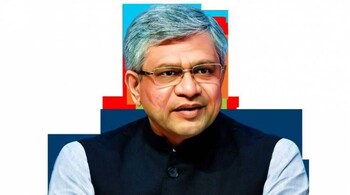
It was only apt that the interviewee was Ashwini Vaishnaw, the Union Minister for Railways, Communications, Electronics & Information Technology.
An alumnus of IIT Kanpur and Wharton, Vaishnaw has been tasked with some of India’s most defining missions.
In an interview with Moneycontrol on board a SPIC travelling from Hosur to Whitefield in the tech hub of Bengaluru, Vaishnaw discussed measures to decongest the city, India's aspirations to become a chip design hub, the transition from import substitution to export-readiness, and the potential risks posed by artificial intelligence (AI) to India's democracy and societal fabric.
Edited excerpts:
You've had quite a hectic day in Bengaluru reviewing various railway projects. What are the plans going forward as far as decongesting the IT hub is concerned?
Bengaluru requires a huge shift from road-based transportation to rail-based transportation. Every large city in the world, Tokyo, Seoul, take any large city – Osaka, New Delhi, all large cities basically manage their transportation by shifting a large part of the commute from road to rail-based transportation.
The entire railway network, which runs across the city – we have reviewed each and every section of it.
Watch: Ashwini Vaishnaw Exclusive | Vande Metro prototypes, chip design in India, AI threat to humanity
Our endeavour will be to increase the capacity of each one of them and run very modern Vande Metro trains on them. Vande Metro trains are being designed right now; the prototypes are being manufactured. Very soon those prototypes will also be out.
Second, the Bengaluru suburban project, a crucial project for the city, is a joint venture in which the state government holds a 51 percent equity stake in the company K-RIDE. We reviewed this project today as well.
Our mission is to rise above politics and deliver to the people.
Third, we have sanctioned Rs 7 crore for the preparation of a Detailed Project Report (DPR) for a ring railway. Basically, if we can construct a complete circular ring railway about 20-25 kilometres outside the main city, it will serve as the hub and spoke model, with seven arteries enabling people to enter and exit the city at a very rapid pace at good volumes.
You've also spoken extensively today about India's progress when it comes to manufacturing, and how it has emerged as a huge powerhouse when it comes to mobile manufacturing. As far as local needs are concerned, we are almost completely self-sufficient. About 99.2 percent of phones are made in India. So, what is the government's goal as far as exports are concerned over the next, say, one to three years? Would you have a target in mind?
This is an industry where it is important to create that critical mass, and we have now crossed that threshold by surpassing $100 billion in electronics production and $44 billion in mobile phone production.
Today, we are in a position where we can move away from the import substitution model and move on to the export-led model. This is a very complex global value chain and some of the components which are required for manufacturing electronics and mobile phones, are very high-precision components.
I am very glad to inform you that a significant number of components are now being manufactured in India due to the increasing volume of the final product. The supply chain is becoming increasingly mature.
In the value chain, we are going higher. And now we have to focus on making it an export-led growth.
Also read: Vande Metro, circular rail to ease Bengaluru's traffic congestion: Ashwini Vaishnaw
Export-led growth is important because it generates significant employment opportunities and creates a vast number of opportunities for the entire supply chain ecosystem. This is our next area of focus.
Another important point to consider is that India is now producing electronic products across a wide spectrum – from telecom equipment and mobile phones to hardware like laptops, servers, PCs, defence electronics, power electronics, and medical electronics. This is happening at a significant scale and volume.
So, will the growth vector now be exports or value addition locally? Because while 99.2 percent of phones are made in India, there are still questions about value addition, how are we scaling that up?
It's an important point. And there are some people who are trying to politicise this issue without understanding the sector.
The global value chain is a complex phenomenon. If you were to map the global value chain of a mobile phone, you would be amazed to see how closely it resembles a spider's web. This highlights the complexity of today's supply chain. Every component will pass borders multiple times.
So, what's extremely important is first and foremost to boost the volume. That's what we have been able to achieve in the past 9-9.5 years. Today, the volumes are very good.
Now, our focus is on enhancing value addition in the country first. Second, to secure more and more design elements, so that you get more for the value of what we produce here.
Third, export-led growth is the goal because our products are now well-established in terms of quality and reliability, which we will leverage in the next level.
Tata and Apple are both ramping up manufacturing here. So, what are the plans in order to bring the entire iPhone component ecosystem to India?
Most components in mobile phones have variants, but the fundamentals remain the same. I generally prefer not to mention specific companies. All mobile phone manufacturers in India have already begun developing component manufacturing. As I said, there are five to six major component subsystems that are now being exported. This growth has already occurred, and we must continue to foster it. We should continuously encourage this trend so that more and more value addition occurs in India and more exports originate from India.
What are India's plans when it comes to enhancing compute and AI chips?
We must look at the entire thing from multiple perspectives. What we are doing at the AMD campus is one of the largest semiconductor product design campuses is getting established in India in Bengaluru. That gives a totally new dimension to chip design.
We have about 3 lakh chip design engineers in India. Many of them are currently designing some of the most complex chips in the world. The success of our semiconductor program has inspired many of them to establish their own product design companies. The more we achieve complete product design locally, the more opportunities we create for further FAB (fabrication) manufacturing processes in our country. Therefore, our focus spans the entire value chain, including the design phase, full product design, FAB, and OSAT (outsourced semiconductor assembly and testing).
Our focus is ensuring that entrepreneurs and startups can create value through product design. We aim for larger companies to transition from providing services to engaging in product design.
You chaired a crucial meeting last week on the issue of deepfakes and said a regulation will be coming. Subsequently, the government also has given a deadline to big tech firms that they need to take down this content within days or risk losing the safe harbour provisions. Do you expect a separate set of regulations? Or do you believe the existing IT rules will be sufficient to crack down on such content?
We are open to every possible solution because this poses a big threat to democracy and our social institutions. I am glad that all platforms have responded in a mature and responsible manner. They are fully willing to cooperate, and we have had two rounds of meetings with them. The next meeting is scheduled for the first week of December. During that time, we will discuss the steps the platforms are willing to take on their own. From our side, we will consider whether new regulations or rules are necessary, or if adjustments within the existing rules are the right solution. Together, we will explore the best course of action.
Will this also determine the way you look at AI regulation going forward? There is also a fear that regulatory capture could end up stifling innovation. So where does India stand in the way it will go about?
We were very successful in creating a balance between innovation and regulation in our privacy bill.
In the case of AI, there are multiple threats. This is a significantly more complex thing compared to privacy regulation because AI can be a major threat to humanity itself.
Today, some of the deep fakes, and misinformation which is created using AI – all these things can actually create huge disturbances in society, our social institutions, and institutions like marriage.
Society must take some action, and that's where we'll have to work together, all of us, the platforms, the society, the regulators, the government – all of us will have to work together and find a solution. I think we should be able to find that solution.
Discover the latest Business News, Sensex, and Nifty updates. Obtain Personal Finance insights, tax queries, and expert opinions on Moneycontrol or download the Moneycontrol App to stay updated!





