

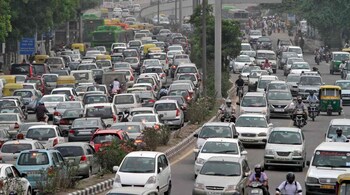
The government, in its Nationally Determined Contributions (NDCs), has committed to reducing the transportation-caused emissions by 33-35 percent. For the same, the government has increased the investments in metro rail construction, provision of BRTs and other travel modes such as light rail, etc. It is pushing incentives for the adoption of clean fuel vehicles, electric vehicles etc. with a laudable objective of reduced dependence on conventional ICT vehicles.
The major urban reform programmes — Smart Cities and AMRUT — have a strong component of solving mobility issues in the cities. Many state governments have formulated EV policies to encourage electric vehicles, particularly two-wheelers, three-wheelers and buses. However, the impact of such policies has not been very encouraging, barring few exceptions like the phenomenal growth of e-rickshaws in many cities.
For effective and efficient policy-making to encourage sustainable mobility solutions, it is important to have both supply and demand-side data, which is often missing, or in short supply. There are numerous examples of such transport projects where the actual utilisation was far less than the projected one. Many public transport projects, BRT, and metro rail systems, failed to realise the desired outcomes in absence of inadequate supply and demand analysis for the paucity of data.
There have been huge discrepancies in the projected and actual utilisation data. As a result, in many transport projects with massive investments, the ridership remains much lower than the projected ones. Cities are often burdened with non-operational bus systems, poorly maintained and utilised BRTS, and metro rail networks. These discrepancies are primarily due to lack of adequate data analysis at the project development stage, and result in huge economic losses due to poor utilisation of transport infrastructure.
For instance, the overestimation of ridership and lack of comprehensive data sharing led to the proposal of both metro and BRTS on the same corridor in Jaipur. Even the fate of Amritsar BRTS, Nagpur metro rail, Lucknow metro rail and rapid metro rail in Gurgaon, among others is the same.
The data available with the policymakers and project planners and developers are mostly supply-side data, such as vehicle registration, sales or production; but the actual vehicle characteristics or the user travel behaviour are not available with the government.
The spatial and infrastructure data is also not monitored and updated. This can be facilitated through technology interventions. In the current time, our devices with artificial intelligence are constantly monitoring our choices, movement pattern, and vehicle demand among various others. Data can be used to improve their service experience and make users more captive to their services.
Data shared with the policymakers will help in adopting a comprehensive approach for planning mobility solutions within the cities. Some of the policy benefits with better data planning are: reduced travel time and cost for commuting; better integration within the modes resulting in seamless travel; common mobility infrastructure; improved road safety; better optimisation of public transport; ease in monitoring the vehicular emissions and local air pollution; better regulated vehicle management, and; implementation of transit-oriented development.
There are also challenges associated with the data access. Data is primarily collected and owned by the private companies; however, the data is collected in their format and questions may raise about the validity of such data. For example, Google Maps majorly monitors data of the private transportation users, and Uber monitors for intermediate transport users such as taxi, bike taxi, and auto users. The private bus agencies or public transport agencies collect user mobility data, but again the quality of the data is questionable. Then, of course, there is a security concern regarding the misuse of individual user data.
There is a need to resolve these challenges for better policy planning to redress the mobility challenges within urban spaces. This could be done by devising a strong data-sharing policy mechanism that could necessitate private companies to share some of the collated data in the form of annual reports for better policy research and implementation.
There is a need for set templates for data collection and monitoring to help evaluate the utilisation of mass infrastructure projects. There should also be regulation for the privacy of individual user travel data. The government should take necessary steps to integrate both demand and supply-side data for better planning.
Discover the latest Business News, Sensex, and Nifty updates. Obtain Personal Finance insights, tax queries, and expert opinions on Moneycontrol or download the Moneycontrol App to stay updated!





